

So, you're trying to figure out if your social media efforts are actually working. How do you move beyond just counting likes and followers to see real business impact? The answer lies in Key Performance Indicators, or KPIs.
A social media KPI is a specific, measurable value that tells you how well you’re hitting your business goals. Think of them as the most critical gauges on your social media dashboard, giving you a clear, at-a-glance report on whether you're winning or losing.
What Are Social Media KPIs Anyway?

Let’s use an analogy. Imagine you're driving from London to Edinburgh. You wouldn't just point the car north and hope for the best. You'd keep an eye on your dashboard – your speed, your petrol gauge, the engine temperature. These are the critical indicators that tell you if you're making good time and if you'll actually make it to your destination.
A social media KPI does the exact same thing for your marketing journey. It helps you navigate.
Your social media channels are constantly churning out data—likes, views, comments, shares, new followers. But not all of this data is a KPI. The real difference is focus. A metric is just a number, like counting the number of lorries you pass on the motorway. A KPI, however, is a vital measurement tied directly to a goal, like the petrol gauge telling you if you’ve got enough fuel to reach Scotland.
Metrics vs. KPIs: What’s the Difference?
This is where a lot of people get tripped up, but getting it right is fundamental to building a solid strategy. A simple metric could be the number of impressions your latest post got. That’s interesting information, for sure, but on its own, it doesn't say much about your business's health.
A KPI, on the other hand, connects that metric to a bigger purpose.
For instance, if your main business goal is to boost brand awareness, then post reach suddenly becomes a hugely important KPI. Why? Because it directly measures how many unique people are seeing your content, which is a perfect indicator of your progress towards that awareness goal.
The core idea is simple: a KPI is a metric that matters. It’s a number you’ve chosen because it directly reflects your progress towards a meaningful business outcome, cutting through the noise of vanity metrics.
Why Setting the Right KPIs Is So Important
Trying to run a social media strategy without clear KPIs is like driving that car to Edinburgh blindfolded. You're definitely moving, but you have no clue if you're on the right road, how fast you're going, or if you're about to run out of petrol.
Setting the right KPIs from day one gives you clarity and focus. It keeps you and your team accountable.
To really get a handle on social media KPIs, it helps to first understand the wider world of social media marketing metrics and how they fit together. This foundational knowledge is key to picking indicators that will genuinely drive your business forward.
Ultimately, choosing the right KPIs means you can:
- Measure what truly matters by tying your social media activity back to real business objectives.
- Demonstrate the value of what you do, showing tangible results and a clear return on investment.
- Make smarter decisions by using solid data to tweak, refine, and improve your strategy over time.
This guide will walk you through the KPIs that count, helping you build a dashboard that will steer your brand straight to success.
Understanding the Four Pillars of Social Media KPIs
Trying to make sense of social media metrics can feel like you're drowning in data. With countless numbers to track, how do you know which ones actually matter for your business? The simplest way to cut through the noise is to group every kpi for social media into one of four core pillars: Reach, Engagement, Conversion, and Loyalty.
Think of this framework as a filing system for your social media data. It helps you connect every single metric back to a specific business goal. Instead of just hoarding numbers, you start to build a clear, compelling story about your performance, from the very first impression you make on a potential customer to fostering a long-term, loyal relationship.
This infographic breaks down the concept beautifully, showing how these four pillars create the foundation for any solid social media measurement strategy.

Each pillar props up a different stage of the customer's journey, giving you a well-rounded and complete picture of your social media impact.
To make this crystal clear, let's break down how these pillars work and which metrics fall under each one.
The Four Pillars of Social Media KPIs and Their Goals
| KPI Pillar | Primary Goal | Example KPIs |
|---|---|---|
| Reach | Measuring brand awareness and audience size. | Follower Count, Impressions, Post Reach, Social Share of Voice (SSoV) |
| Engagement | Gauging audience interaction and content resonance. | Likes, Comments, Shares, Saves, Mentions, Average Engagement Rate |
| Conversion | Tracking actions that drive direct business value. | Click-Through Rate (CTR), Conversion Rate, Cost-Per-Conversion, Sales Revenue |
| Loyalty | Assessing long-term customer relationships and advocacy. | Customer Lifetime Value (CLV), Brand Mentions, Customer Satisfaction (CSAT) |
This table neatly summarises the framework. Now, let's explore what each pillar really means for your strategy.
Pillar 1: Reach KPIs
Reach is all about awareness. This pillar measures the sheer size of your audience and how many unique pairs of eyes your content is actually getting in front of. It directly answers the question, "How many people are we talking to?"
If your main objective is to build brand recognition and simply get your name out there, then Reach KPIs should be your North Star.
Key Reach KPIs include:
- Follower Count: The number of people who have opted in to see your content.
- Impressions: The total number of times your content was displayed on a screen.
- Post Reach: The number of unique accounts that saw a specific post.
- Social Share of Voice (SSoV): How much of the conversation around your industry is about your brand versus your competitors.
These metrics tell you just how far your message is travelling. When your reach is growing, you know your brand is becoming more visible to the people you want to attract.
Pillar 2: Engagement KPIs
Once you've reached an audience, the next big question is, "Are they even listening?" This is where Engagement KPIs come in. They measure how people are actually interacting with your content.
High engagement is a fantastic sign that your content is hitting the mark, sparking conversations, and building a genuine community around your brand. These are the numbers that prove you have an active, interested audience, not just a sea of passive scrollers.
For instance, the platform you choose makes a huge difference. In Germany, Facebook holds nearly 48% of the social media market share, but the average engagement rate per post is a tiny 0.48%. Compare that to Instagram Reels, which can see rates as high as 1.22%. This shows why you can't treat all platforms the same. If you want to learn more, you can discover more about German social media trends to refine your strategy.
Engagement is the currency of social media. It transforms a one-way broadcast into a two-way conversation, which is the foundation for building trust and relationships with your audience.
Pillar 3: Conversion KPIs
This is where your social media efforts start to have a direct, measurable impact on your business's bottom line. Conversion KPIs track when a user takes a specific, valuable action after seeing your content. That action could be anything from clicking a link to making a full-blown purchase.
These KPIs are absolutely essential for proving the return on investment (ROI) from your social media activities. They answer the all-important question, "Is our social media actually driving valuable actions for the business?"
Common Conversion KPIs are:
- Click-Through Rate (CTR): The percentage of people who saw your post and clicked a link in it.
- Conversion Rate: The percentage of users who completed a goal (like signing up for a newsletter or downloading a guide).
- Cost-Per-Conversion: How much you had to spend, on average, to get one person to convert.
- Sales Revenue: The direct income generated from social media referrals.
Tracking these numbers helps you understand how well your content persuades people to move from being passive viewers to active participants in your brand's world.
Pillar 4: Loyalty KPIs
Finally, we have Loyalty. These KPIs measure the long-term health of your brand and the strength of its relationships with customers. It's not about one-off conversions; it's about creating true brand advocates who stick around, buy from you again, and tell all their friends about you.
This pillar helps you answer, "Are we building a sustainable community of fans?"
Loyalty is often measured through metrics like:
- Customer Lifetime Value (CLV): The total revenue you can expect from a single customer over the entire course of their relationship with you.
- Brand Mentions: Keeping an eye on both tagged and untagged mentions to understand what people are saying.
- Customer Satisfaction Score (CSAT): Directly asking customers how happy they are with their experience.
By focusing on these four pillars, you can build a balanced and incredibly effective measurement strategy. This structured approach ensures you're always choosing the right kpi for social media to match your unique business goals, whether that’s blowing up your audience or nurturing deeper customer relationships.
How to Select the Right KPIs for Your Business
Choosing the right KPIs for social media isn’t about picking fancy-sounding metrics from a long list. It's about building a measurement plan that actually reflects what you’re trying to achieve as a business.
Without that connection, you end up chasing vanity metrics—numbers that look great in a report but don’t move the needle. It’s like meticulously counting the cars on the motorway when your real goal is to get to your destination faster. The data might be accurate, but it’s completely irrelevant.
The secret is to tie every social media action back to a real, tangible business outcome. This process doesn't start on your social media dashboard; it starts with your core business objectives.
Start with Your Business Goals
Before you even think about likes or shares, take a step back and ask a simple question: What does our business need to accomplish right now? Are you a startup desperate to get your name out there, or an established e-commerce store trying to drive more sales? Your answer is the foundation for everything that follows.
Once you have a clear, high-level objective, you can craft a specific, measurable social media goal to support it. The SMART framework is perfect for this:
- Specific: Clearly define what you want to achieve. No vague wishes.
- Measurable: Make sure you can track your progress with actual numbers.
- Achievable: Set a goal that’s ambitious but realistic for your team and budget.
- Relevant: Ensure the goal directly helps your bigger business objective.
- Time-bound: Give yourself a deadline.
This simple exercise transforms fuzzy hopes into a concrete plan, giving you the clarity needed to pick the most impactful KPIs. For a deeper dive, check out our guide on creating a winning social media content strategy, which is the perfect next step after defining your KPIs.
Align KPIs with Your SMART Goals
Let's make this real. Imagine you run an online clothing boutique based in Germany.
Your main business objective is to increase overall company revenue. Pretty straightforward.
Using the SMART framework, you create a social media goal to support this: Increase online sales generated from social media by 15% during Q3.
See how much clearer that is? It's specific (online sales from social), measurable (15%), achievable (let's assume it's based on past growth), relevant (it directly fuels revenue), and time-bound (Q3).
With a goal this sharp, picking the right KPIs becomes almost effortless. You’re not guessing anymore. You would immediately prioritise tracking:
- Conversion Rate: What percentage of people coming from social media actually buy something? This is your number one indicator of success.
- Cost-Per-Acquisition (CPA): On average, how much are you spending to get one new customer through social media? This keeps your spending efficient.
- Social Media ROI: Are you making more money than you're spending? This metric proves the financial value of your efforts.
Suddenly, metrics like follower count, while nice to have, fade into the background. The KPIs you’ve chosen are directly locked onto your goal of driving sales.
Consider Your Audience and Platform
Finally, remember that the right KPIs also depend heavily on who you're talking to and where you're talking to them. Different platforms have different strengths, and different audiences behave in unique ways.
Let's go back to our German clothing boutique. Perhaps you're targeting a younger audience. Surveys on social media use in Germany reveal that for Gen Z, Instagram is king, easily beating Facebook. This crucial insight tells you to focus your KPIs on what works on Instagram—things like Story Reach, Reels Views, and engagement with influencer content. Trying to measure success using Facebook-centric metrics would be a waste of time. You can learn more about these generational differences in social media usage to fine-tune your approach.
Choosing the right KPIs is an act of strategic alignment. It’s the critical process of translating your broad business vision into a focused, data-driven action plan for your social media team.
By connecting your KPIs to clear business goals and tailoring them to your audience and platforms, you ensure every number you track is another step towards genuine, measurable success.
The Social Media KPIs You Actually Need to Track
Alright, you’ve got your strategy sorted. Now it’s time to get into the nitty-gritty: the numbers. Choosing the right kpi for social media isn’t about tracking every single metric under the sun. It's about zeroing in on the handful of numbers that truly reflect whether you're hitting your goals.
Think of this list as your essential toolkit. We'll break down the most critical KPIs—the ones that give you real, actionable insights—across the four pillars that matter most: Reach, Engagement, Conversion, and Loyalty.
Are People Seeing Your Stuff? KPIs for Reach and Awareness
Reach KPIs are your first checkpoint. They answer a simple but vital question: "Is our message actually getting out there?" These are the bedrock of any brand awareness effort.
-
Reach: This is the big one. It's the total number of unique people who saw your content. Don’t confuse it with impressions, which just counts total views (one person could see your post five times). Reach tells you the true size of the audience you’ve managed to capture. It's a pure measure of how far your content has spread.
-
Social Share of Voice (SSoV): This is where you size yourself up against the competition. SSoV tells you how much of the conversation in your industry revolves around your brand. Are you a whisper or a roar? To figure it out, you track mentions of your brand against your competitors over a set period.
SSoV Formula: (Your Brand Mentions / Total Mentions [Yours + Competitors']) x 100 = Your SSoV (%)
When your SSoV is climbing, it's a solid sign that you’re carving out a bigger piece of the market's attention—a fantastic indicator of a growing brand presence.
Is Anyone Listening? KPIs for Gauging Audience Engagement
Engagement metrics are where you see if your content is landing. It’s one thing for people to see your posts, but it’s another for them to actually interact with them. High engagement is the heartbeat of a healthy, thriving community.
Here in Germany, for instance, the digital advertising market is poised to grow by 10% in 2025, which really puts the pressure on making every social media effort count. Platform choice is everything. A quick look at the numbers shows TikTok leading engagement in Germany with a 5.4% average rate, leaving Instagram Reels (1.22%) and even Facebook (0.48%) in the dust. This tells you a one-size-fits-all approach is a recipe for failure; you have to know where your audience is most active.
The most crucial engagement KPI is Engagement Rate. It’s the great equaliser. It puts your likes, comments, and shares into context by measuring them against your audience size or reach, giving you a standard way to see what's truly working.
There are a few ways to slice this, but a common formula is:
Engagement Rate Formula: (Total Engagements on a Post / Total Reach of that Post) x 100 = Engagement Rate (%)
Keeping an eye on this helps you double down on the content your audience genuinely loves. For a deeper dive into making sense of these numbers, check out our detailed article on social media performance indicators.
Is It Driving Action? KPIs for Tracking Conversions
This is where the rubber meets the road. Conversion KPIs are how you prove that your social media efforts are directly contributing to the bottom line. These metrics track the moments a follower takes a meaningful action, turning them from a passive viewer into a lead or a customer.
-
Click-Through Rate (CTR): How good are you at getting people to click that link? CTR tells you exactly that. It’s a direct measure of how compelling your call-to-action is. A high CTR means you’re successfully persuading people to leave the social platform and visit your turf.
CTR Formula: (Total Clicks on a Link / Total Impressions of the Post) x 100 = CTR (%)
-
Conversion Rate: This is the ultimate proof of value. It’s the percentage of people who came from social media and actually did the thing you wanted them to do—whether that’s buying a product, signing up for a newsletter, or downloading your latest guide. You'll need analytics tools with proper goal tracking set up for this one.
-
Cost Per Click (CPC): If you're putting money behind your posts, CPC is non-negotiable. It tells you, on average, how much you're shelling out every time someone clicks your ad. A low CPC is a beautiful thing; it means you’re reaching the right people efficiently and getting more bang for your buck.
Are They Sticking Around? KPIs for Assessing Customer Loyalty
Finally, let's talk about the long game. Loyalty KPIs help you measure the health of your customer relationships. This goes way beyond a one-time purchase; it's about building a community of people who will champion your brand.
-
Customer Satisfaction Score (CSAT): Want to know if your customers are happy? Just ask them. CSAT is usually measured with a simple survey (e.g., "Rate your satisfaction from 1-5"). Tracking this score, especially after social media customer service interactions, gives you a direct pulse on how well you're serving your community.
-
Brand Mentions: Keep your ears to the ground by monitoring every mention of your brand—both when you're tagged and when you're not. A steady rise in positive, unsolicited mentions is one of the strongest signals you have that you're building genuine loyalty and turning customers into advocates.
Let's pull all of this together into a handy reference.
Key Social Media KPI Formulas and Importance
Here's a quick-reference table to keep these essential metrics straight. It covers how to calculate each KPI and, more importantly, what it tells you about your social media strategy.
| KPI | How to Calculate It | Why It Is Important |
|---|---|---|
| Reach | The number of unique accounts that viewed your content. | Measures the total size of your audience and the spread of your message. |
| Social Share of Voice (SSoV) | (Your Mentions / Total Industry Mentions) x 100 |
Shows your brand's visibility and market presence compared to competitors. |
| Engagement Rate | (Total Engagements / Total Reach) x 100 |
Indicates how well your content resonates with your audience. |
| Click-Through Rate (CTR) | (Total Clicks / Total Impressions) x 100 |
Measures the effectiveness of your call-to-action and link content. |
| Conversion Rate | (Conversions / Total Clicks) x 100 |
Directly ties social media activity to business goals like sales or leads. |
| Cost Per Click (CPC) | Total Ad Spend / Total Clicks |
Measures the cost-efficiency of your paid social media campaigns. |
| Customer Satisfaction (CSAT) | (Positive Responses / Total Responses) x 100 |
Provides a direct measure of customer happiness with your brand/service. |
By consistently tracking a balanced mix of these KPIs, you’re essentially building a performance dashboard for your social media efforts. This data-driven approach lets you move beyond guesswork, empowering you to make smarter decisions that drive real, meaningful results for your business.
Tools and Techniques for Measuring Your KPIs
Knowing which social media KPIs to track is one thing, but actually measuring them accurately is a whole different ball game. This is where the right tools come in, turning a flood of raw data into insights you can actually use. Think of it as the difference between knowing you need a map and having a live GPS guiding you turn-by-turn.
Thankfully, there’s a whole spectrum of tools out there, from the free analytics built right into the platforms to powerful, all-in-one software suites. The trick is to find the right mix that fits your goals, your team, and your budget.
Starting with Native Analytics Platforms
Every social network gives you a free peek behind the curtain with its own analytics dashboard. For anyone just starting out, these are the absolute best place to begin. The data is coming straight from the source, it costs nothing, and it’s packed with foundational metrics.
- Facebook & Instagram Insights: The Meta Business Suite is surprisingly powerful, giving you a solid look at reach, engagement rates, who your audience is, and how your videos are performing across both platforms.
- X (formerly Twitter) Analytics: This dashboard is great for getting a quick pulse on your content. It shows you tweet impressions, how many people are visiting your profile, and which posts are getting the most attention.
- LinkedIn Analytics: If you’re in the B2B space, this is your command centre. It provides fantastic insights into visitor demographics, page views, and the performance of your company updates.
- Pinterest Analytics: For brands driving traffic, this is where you'll want to live. You can easily track impressions, saves, and those all-important outbound clicks to your website.
The only real downside? These native tools live on their own little islands. You have to hop from one platform to the next to pull your data, which gets old fast.
Upgrading to Third-Party Management Tools
When you're ready to get serious and bring all your data under one roof, it’s time to look at third-party management tools. Platforms like Sprout Social, Hootsuite, or Buffer pull everything from your different social profiles into a single, cohesive dashboard.
They come with some serious perks:
- Centralised Dashboards: See how you're doing across every single network, all on one screen. No more tab-switching madness.
- Advanced Reporting: Create beautiful, custom reports that actually show your progress over time. Perfect for sharing with your boss or clients.
- Competitive Analysis: Many of these tools let you peek at what your competitors are up to, giving you crucial context for your own performance.
To get a better grip on how these systems work, diving into guides on analytics for social media can really help you build out a measurement strategy that works.
Creating a Visual KPI Dashboard
Whichever tools you land on, your end goal should be to create a social media dashboard. A dashboard is simply a visual snapshot of your most important KPIs, letting you see at a glance how you’re doing and whether you’re on track to hit your goals.
A great dashboard doesn't just show you numbers; it tells you a story. It should instantly answer your biggest questions: "Are we growing?", "Is our content connecting?", and "Are we actually hitting our targets?"
This visual approach makes it so much easier to spot trends, catch problems early, and explain your results to people who don't live and breathe social media metrics. You can build these within advanced tools or even create your own with something like Google Data Studio.
And when it comes to understanding how people feel about your brand, exploring the best sentiment analysis tools is a must. Integrating these adds a rich, human layer to your data, giving you the full picture of your brand's impact.
Optimising Your Strategy Based on KPI Analysis
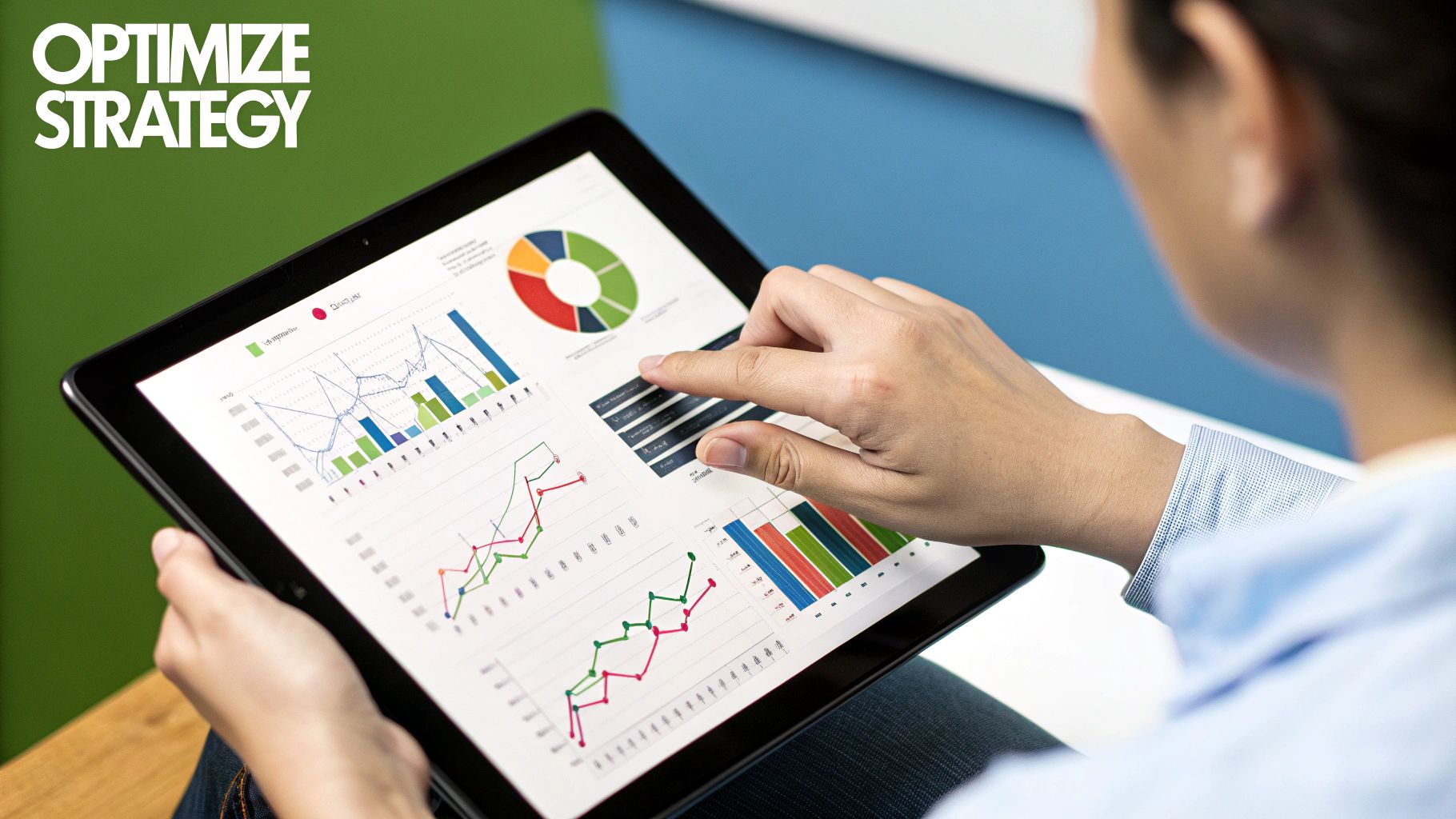
Watching your social media KPIs is only half the battle. The real magic happens when you use that data to make smart, decisive moves. Think of your analytics dashboard less like a report card and more like a live roadmap, pointing out exactly where you need to go next to get better results.
Honestly, collecting data without acting on it is like seeing your car's petrol gauge on empty and just… continuing to drive. The warning is useless until you do something about it.
This is where strategic optimisation comes in. It’s all about looking at the numbers, understanding what they’re telling you, and making intelligent tweaks to improve your social media game.
Turning Insights into Actionable Steps
So, what does this actually look like day-to-day? Let’s walk through a couple of common situations you’ll almost certainly encounter. Each one is a problem your KPIs will flag, and each has a clear, actionable solution.
Let's say your Engagement Rate is through the roof, but your Conversion Rate has completely stalled. It’s a classic head-scratcher. Your audience clearly loves your content, but for some reason, they just aren't taking that final step to buy, sign up, or download.
This usually points to a breakdown between your engaging content and your call-to-action (CTA). It’s time to play detective:
- Is your CTA obvious? Is it compelling and easy to spot, or is it buried?
- What about the landing page? Does it feel like a natural next step from your social post, or is the experience jarring and disconnected?
- Could there be a technical issue? Click through the entire process yourself. Are there broken links or too many hoops to jump through?
Testing Your Way to the Top
Here’s another one you’ll see all the time: your Post Reach is in a slow, steady decline. This is a massive red flag. It tells you your content isn't hitting the mark with the algorithm or your audience the way it used to.
Don't just throw random ideas at the wall to see what sticks. Use this data to create a proper testing plan. This is where A/B testing becomes your most valuable tool, allowing you to systematically try out different things to see what actually moves the needle.
KPIs aren't just for reporting on what already happened. They're your crystal ball for shaping the future. They give you the hard evidence to stop guessing and start making data-backed decisions that drive real growth.
By testing just one variable at a time, you can figure out exactly what works:
- Switch up your content formats: If static images are getting stale, why not try a quick video, a carousel post, or an interactive poll?
- Play with your posting times: People's online habits change. Test different days and times to find when your audience is most active now.
- Tweak your headlines and images: Sometimes a different visual or a punchier opening line is all it takes to grab someone's attention in a crowded feed.
When you use your KPI data to spot weaknesses and then test potential fixes, you create a powerful feedback loop. This cycle of measure, interpret, test, and repeat is what fuels a winning social media strategy. It turns your KPIs from boring numbers into your personal guide for constant improvement.
Frequently Asked Questions
Diving into social media analytics can feel like learning a new language. Let's clear up some of the most common questions people have when picking the right KPI for social media.
What’s the Real Difference Between a Metric and a KPI?
Think of it like this: a metric is any piece of data you can count—likes, followers, video views, you name it. A KPI, or Key Performance Indicator, is a metric you’ve hand-picked because it tells you if you're actually getting closer to a specific business goal.
For example, the number of likes your latest post got is a metric. But if your main goal is to build a loyal community, then your Engagement Rate becomes the KPI. Why? Because it measures how deeply your content is connecting with people, not just how many saw it. Essentially, all KPIs start as metrics, but only the most important metrics earn the title of KPI.
How Many KPIs Should I Actually Be Tracking?
There isn't a single magic number, but when it comes to KPIs, less is definitely more. If you try to track everything, you'll end up tracking nothing meaningful. It's a classic case of analysis paralysis.
A great rule of thumb is to stick to 3–5 core KPIs for each major business goal. This approach forces you to focus on what truly matters and keeps your reporting from becoming a cluttered mess.
If your goal is to generate leads, for instance, you’d zero in on KPIs like Click-Through Rate, Conversion Rate, and maybe Cost Per Lead. Everything else is just noise.
Which KPIs Are Best for a Small Business?
When you're running a small business, every minute and every pound counts. Your KPIs need to show a clear return on that investment. The best place to start is with metrics that directly link your social media efforts to real-world results.
If you're just getting started, concentrate on these three:
- Engagement Rate: This tells you if you're building a real relationship with your audience, which is the bedrock for any small brand.
- Website Referral Traffic: This proves your social media isn't just a popularity contest—it's actively sending potential customers to your website.
- Conversion Rate: This is the ultimate proof. Whether it's someone signing up for your newsletter or buying a product, this KPI ties your social media work directly to business growth.
Ready to stop guessing and start posting with purpose? Trustypost is your AI-powered social media assistant, generating on-brand content ideas and scheduling them in minutes. Stop the content grind and start turning attention into leads. Discover how Trustypost can streamline your social media today.