

A social media content plan is simply your roadmap for what to post, when to post it, and most importantly, why it matters. It’s the difference between just throwing content out there and strategically moving your business forward.
Build a Foundation for Social Media Success
Before you even draft a single tweet or film a Reel, you need to lay the groundwork. A solid content plan always starts with clear goals – goals that are about more than just racking up followers. If your content doesn't have a purpose, it’s just noise. Every post has to tie back to your bigger business objectives.
This is a classic stumbling block for so many brands. It’s easy to get caught up chasing vanity metrics like follower counts instead of focusing on what actually grows the business, like building a loyal community or driving sales.
Define Your Purpose with SMART Goals
The best way to get serious about your objectives is to use the SMART framework. It forces you to make your goals Specific, Measurable, Achievable, Relevant, and Time-bound. A vague wish like "get more engagement" is useless.
A proper SMART goal sounds more like this: "Increase our Instagram engagement rate by 15% over the next quarter by posting three Reels and four interactive Stories per week." See the difference? That goal gives you a clear target and a defined path to get there.
A few more examples of strong, goal-oriented objectives:
- Generate 50 qualified leads from LinkedIn within six months.
- Increase website click-throughs from Facebook by 20% in Q3.
- Boost brand awareness by achieving 500,000 impressions on TikTok over the next month.
Think of a well-defined goal as your North Star. It guides every single content decision, from the topics you cover to the formats you choose. It stops you from wasting time and helps you get a real return on your efforts.
Get to Know Your Audience Deeply
With your goals in place, it’s time to figure out exactly who you’re talking to. And I don’t mean broad categories like "millennial women." To create content that actually resonates, you need to build detailed audience personas. This is the difference between shouting into a void and having a real conversation.
A persona is basically a fictional character representing your ideal customer. Give them a name, a job, and think about their daily challenges, where they spend their time online, and what makes them tick. What problems are they trying to solve? What kind of content makes them stop scrolling? Our guide on how to build your brand offers some great strategies for this foundational work.
These details really matter. For example, if you're targeting a German audience, you'd want to know that Facebook is still huge there, with 43.6 million users, and that the 25-34 age group is the largest. This demographic loves visually engaging content like polls and live videos. Knowing specifics like this can completely shape your strategy.
As you lay this foundation, weaving in a strong video strategy can be a game-changer. For an audience that loves visual content, creating a winning video content marketing strategy can massively boost your engagement and get you to your goals faster. This isn’t just theory—it’s the essential groundwork that turns random posting into a high-performing content machine that hits the mark every single time.
Pick Your Platforms and Pinpoint Your Content Pillars
Let's get one thing straight: trying to be everywhere on social media is a surefire recipe for burnout. The secret to a winning social media plan isn't about blanketing every platform; it's about focusing your energy where it actually counts. You need to be where your ideal audience is already spending their time.
Spreading yourself too thin just waters down your message and makes it impossible to build any real traction. The goal is to choose a few key platforms and really own them. This targeted approach means your content connects with the right people, giving you maximum impact without stretching your team to its breaking point.
The infographic below really drives home how understanding your core goals and audience should be the bedrock of every strategic choice you make.
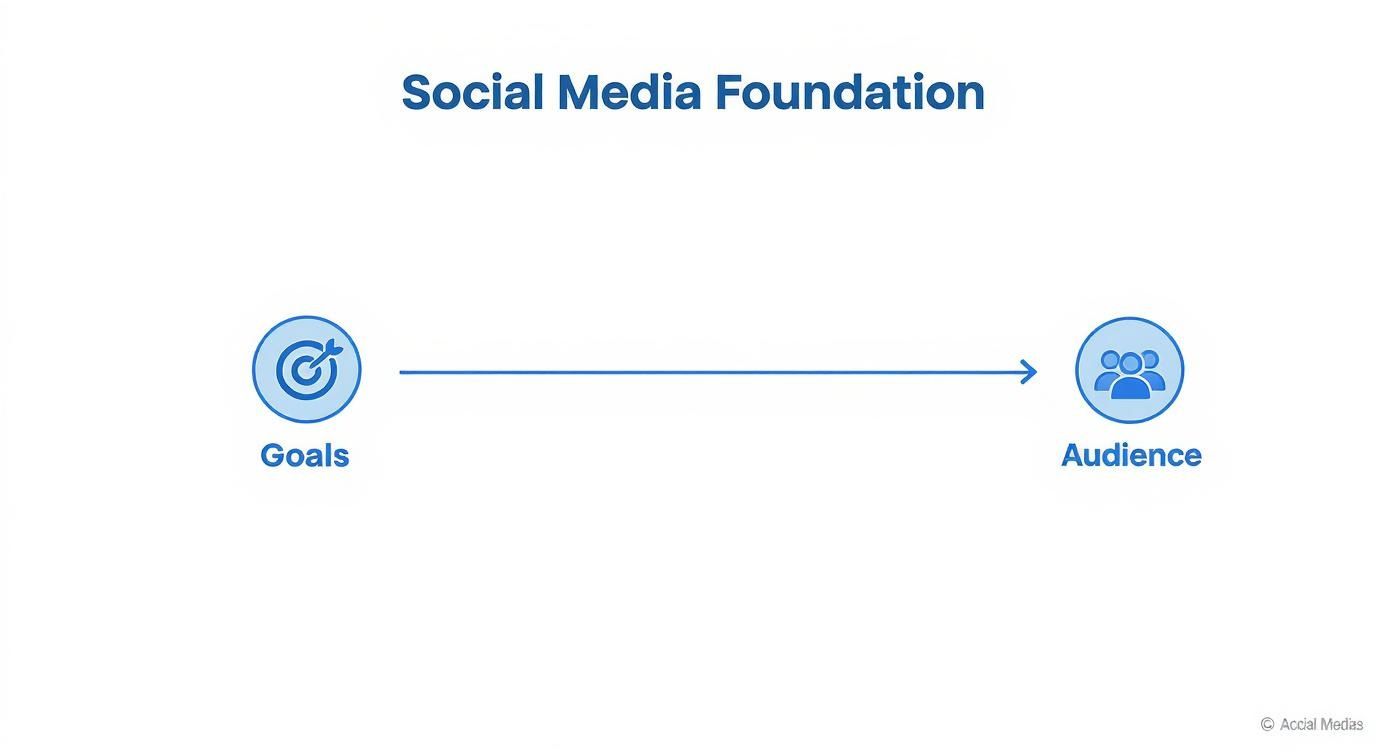
As you can see, choosing a platform isn't some random decision. It's a direct result of knowing exactly who you want to talk to and what you hope to achieve.
Choosing Your Core Social Media Platforms
So, where should you plant your flag? The answer is always found where your audience's habits and your brand's strengths overlap.
Take the German market, for example. The average social media user there has 5.9 different accounts, with younger people flocking to Instagram, Snapchat, and TikTok. This tells you a single-platform strategy probably won’t cut it if you're trying to reach a broad German audience. It's always a good idea to dig into German social media usage habits to make an informed decision.
Your platform choice also hinges on what kind of content you're good at creating. If you’re a great writer but struggle with video, that’s going to influence your decision.
Matching Platforms to Your Audience and Goals
To make this a bit easier, I've put together a quick matrix. Think of it as a cheat sheet for aligning platforms with your brand's specific audience and business objectives.
| Platform | Primary Audience | Best Content Formats | Key Business Goal |
|---|---|---|---|
| B2B Professionals, Industry Leaders, Job Seekers | Articles, White Papers, Case Studies, Company News, Text-heavy Posts | Lead Generation, Thought Leadership, Talent Recruitment | |
| Millennials & Gen Z, Visual-driven Consumers (B2C) | High-quality Photos, Reels, Stories, Carousels | Brand Awareness, Community Building, E-commerce Sales | |
| TikTok | Gen Z & Younger Millennials | Short-form Vertical Video, Trends, User-Generated Content | Reaching New Audiences, Driving Virality, Brand Personality |
| Broad Demographic (Gen X & Boomers) | Video, Community Groups, Events, Photo Albums, Links | Community Engagement, Local Business Traffic, Customer Service |
This table isn't exhaustive, but it's a solid starting point for seeing where your efforts will likely yield the best results.
One of the biggest mistakes I see is businesses choosing a platform just because it’s trending. If your target audience is senior B2B executives, you have no business being on TikTok, no matter how fun it looks. Go for depth on the right platforms, not a shallow presence on all of them.
Define Your Content Pillars
Once you’ve settled on your platforms, it’s time to define your content pillars. These are the 3-5 core themes or topics you’ll consistently talk about. Think of them as the main subjects in your brand’s curriculum.
They provide structure, keep you from posting random, off-brand content, and build a cohesive, authoritative social media presence. Your pillars tell your audience exactly what to expect from you, which builds trust and positions you as the go-to expert in your niche.
How to Establish Strong Content Pillars
To figure out your pillars, sit down with your team and hash out the answers to these questions:
- What are our true areas of expertise? What do we know inside and out?
- What problems are our customers constantly struggling with? How can our knowledge genuinely help them?
- What are we actually passionate about as a brand? Real enthusiasm is magnetic and will come through in your content.
For instance, a financial advisor I worked with landed on these pillars:
- Retirement Planning: Actionable tips for long-term saving.
- Investment Demystified: Breaking down complex investment jargon.
- Market News & Analysis: Timely takes on economic trends.
- Client Success Stories: Showcasing real-world results to build credibility.
Every single post they create now fits neatly under one of those pillars. This framework makes content creation a whole lot easier and guarantees every post reinforces their core message. It’s how you build a focused, valuable feed that doesn't just attract followers, but turns them into loyal customers.
Find the Right Mix for Your Content Creation
Let's be honest: a social media feed that only ever talks about itself is boring. No one wants a constant sales pitch. If you truly want to build a powerful presence, you have to think beyond just promoting your own stuff.
The most successful brands I've worked with have mastered a dynamic mix of original, curated, and user-generated content (UGC). This approach does two things brilliantly: it keeps your audience genuinely interested, and it stops your content team from burning out. When you get this balance right, your social media stops being a one-way broadcast and starts feeling like a real conversation. You shift from being just another seller to a central, trusted voice in your industry.

Nail Your Original Content
This is the stuff you create from scratch. It’s the heart and soul of your brand's voice—your blog posts, behind-the-scenes videos, custom infographics, and handy tutorials. Every piece of original content should tie directly back to your core content pillars, giving you a perfect platform to showcase what makes you unique.
But we've all been there, staring at a blank content calendar, waiting for inspiration to strike. It can be intimidating. I use a simple brainstorming method I call "Pillar Probing" to get the ideas flowing.
For each of your main content pillars, just ask yourself these three quick questions:
- What's a common myth I can bust? Tackle a popular misconception in your field and set the record straight.
- What's a "how-to" I can simplify? Take a complex process and break it down into dead-simple, actionable steps for your audience.
- What's a recent success story? Share a specific (but anonymised) client win that perfectly illustrates the value you provide.
This little trick helps ensure your original content is always adding value and reinforcing your expertise on the topics you want to be known for.
The Understated Power of Curation
Curated content is simply sharing valuable, relevant information from other credible sources. This isn't about laziness or stealing ideas. It’s about positioning yourself as a trusted filter for your audience, saving them the time and effort of finding the good stuff themselves.
Think of it like being a helpful guide. When you share a thought-provoking article from an industry leader or a compelling statistic from a new research report, it shows you're secure, connected, and have your finger on the pulse.
Curation is a massive trust-builder. When you consistently share high-quality content—even when it's not yours—you become an indispensable resource. People learn that following you means staying informed about the entire industry, not just your little corner of it.
The key to doing this well is to always add your own spin. Don't just hit "share." Add a short intro like, "This is a fascinating take on the future of remote work because…" This simple addition ties the piece back to your brand's perspective and gives your audience a reason to care.
Let Your Audience Fuel Your Feed with UGC
User-Generated Content (UGC) is any content—photos, videos, reviews, you name it—created by your audience instead of your brand. Honestly, it’s probably the most powerful form of social proof you can get.
When a customer posts a picture of your product out in the wild, they’re giving you a genuine, unfiltered endorsement. This kind of content is often seen as far more trustworthy than anything you could create because it comes from a real person with no agenda.
How to Get More UGC (and What to Do with It)
You can’t just sit back and hope for UGC to appear. You need to actively encourage it. Here are a few proven ways to get the ball rolling:
- Create a Branded Hashtag: Come up with a unique, memorable hashtag. Plaster it everywhere: in your bio, on your packaging, in your posts. A fitness apparel brand, for example, could use something like
#SweatInStyleto gather customer workout snaps. - Run a Contest or Giveaway: Nothing gets people moving like a good prize. Offer something desirable for the best photo or video featuring your product. This can create a huge wave of content and excitement.
- Just Ask! Sometimes, the direct approach is best. Prompt your audience with a simple question. A local coffee shop might post, "Show us your favourite reading spot with our coffee!" and then feature the best submissions on their feed.
A quick but critical reminder: always ask for permission before you repost someone's content, and always give them proper credit by tagging their account in both the photo and the caption. When you feature your customers, they feel seen and valued, which is how you turn passive followers into passionate brand advocates.
Map Out Your Social Media Content Calendar
This is where the rubber meets the road. All that research and strategy you’ve just done is about to become a concrete, actionable plan. A social media content calendar is what turns your great ideas and content pillars into a real schedule, finally ending that daily "what on earth do I post?" panic.
Think of it as the single source of truth for everything you publish on social. A well-kept calendar isn't just a schedule; it's a tool for ensuring consistency, which is absolutely vital if you want to build and keep an audience. It gives you a bird's-eye view, letting you plan ahead for important dates and maintain a healthy mix of content over time.

What Actually Goes in the Calendar?
For your calendar to be genuinely useful, every entry needs a bit of detail. Simply scribbling "product post" on a Tuesday isn't going to cut it when you're in a rush. Each item on your schedule should be a complete package, ready to go.
Here are the details I never leave out for any post:
- Platform: Be specific. Is this for the Instagram Feed, a LinkedIn article, or your Facebook Group?
- Date and Time: Nail this down. Knowing when your audience is most active is crucial for getting eyeballs on your content.
- Topic & Pillar: What’s the post about, and which of your core content pillars does it support? This is your brand-consistency check.
- Format: Is it a single image, a Reel, a carousel, a Story, or a simple text update?
- Visuals: I always include a direct link to the final image or video file. No more frantic searching through Google Drive folders.
- Caption/Copy: The full, proofread text should be right here, ready to copy and paste.
- Hashtags & Tags: A complete list of hashtags and any accounts you plan to tag.
- Status: A simple tracker (like Idea, In Progress, Ready for Review, Scheduled) makes it easy for the whole team to see where things stand at a glance.
Choosing Your Calendar Tool
You don’t need to overcomplicate this. Honestly, the best tool is the one you’ll actually use consistently. Your choice really boils down to your budget, how big your team is, and how many accounts you're juggling.
If you're focusing heavily on professional networking, you might find this a comprehensive guide on creating a LinkedIn content calendar especially useful for that platform.
Simple Spreadsheet Solutions
Never underestimate the power of a good old Google Sheet or Excel file. It's a fantastic, zero-cost way to get started. You can easily create columns for all the essential details I mentioned and build a custom calendar view. It's flexible, easy to share, and perfect for solopreneurs or small teams just getting organised.
Dedicated Social Media Management Platforms
This is where things get more serious. Tools like Trustypost, Buffer, or Sprout Social are designed specifically for this. They combine your content calendar with powerful scheduling features, analytics, and team collaboration tools. Being able to plan, get approvals, and schedule everything across multiple networks from one place is a huge time-saver.
The real magic of these platforms is automation. You can batch-create your content for the next few weeks, schedule it all in one go, and then step back. It frees you up to focus on the human side of things, like engaging with your community.
It also helps to know your local audience's habits. In Germany, for example, the average person spends about 1 hour and 41 minutes on social media each day. While Facebook's popularity has dipped a bit, YouTube is still massive, with users spending over 50 minutes per day on the platform, especially younger people. Knowing these small details helps you nail your timing for maximum impact.
The Power of Scheduling in Advance
Ultimately, scheduling your content ahead of time is the main goal here. It’s what flips social media management from a reactive, high-stress chore into a proactive, organised system.
When you block out time to prepare and schedule posts in advance, you guarantee a consistent presence, even on your busiest days. It's the key to staying visible without burning out.
If you're ready to get this workflow dialled in, our guide on how to schedule social media posts breaks down the exact steps to streamline the whole process. This organised approach is how you reclaim your time, slash your stress levels, and execute your social media plan perfectly.
Measure Performance to Optimise Your Plan
Hitting "publish" on a post feels like the finish line, but it’s really just the starting gun. The real work—and the real success—comes from listening to what your data is telling you. This is where you move from making educated guesses to making informed decisions that actually grow your brand.
It's all too easy to get caught up in "vanity metrics" like follower count. While nice to see, they don't paint the full picture. Instead, we need to focus on performance metrics that show us whether our plan is actually working and contributing to our business goals. This is how analytics stops being a chore and becomes your most valuable strategic partner.
Identifying the KPIs That Actually Matter
The goals you set right at the beginning should be your guide here. Don't fall into the trap of tracking every single number available. Instead, laser-focus on the key performance indicators (KPIs) that directly link back to what you’re trying to achieve. Every platform’s native analytics dashboard is a treasure trove of this data.
Here are a few of the essentials I always keep an eye on:
- Engagement Rate: This one is huge. It’s the combination of likes, comments, shares, and saves, viewed as a percentage of your audience. A high engagement rate is the clearest sign that your content is hitting the mark.
- Reach and Impressions: Think of reach as the number of unique people who saw your post, while impressions are the total number of times it was shown. If brand awareness is your game, these are your core metrics.
- Click-Through Rate (CTR): This tells you how many people actually clicked a link in your post. For anyone trying to drive traffic to a website or landing page, CTR is non-negotiable.
- Conversions: This is where the rubber meets the road. A conversion is when someone takes that final, desired action—like signing up for your newsletter or buying a product. It's the ultimate measure of direct business impact.
If you want to go deeper, our guide on the most important social media KPIs can help you build out a really solid tracking framework. Getting comfortable with these numbers is the first step toward making much smarter content decisions.
Decoding Key Social Media Metrics
To help you get a clear picture, here's a quick reference guide. It breaks down what each metric measures and why it should be a part of your regular content analysis.
| Metric | What It Measures | Why It's Important |
|---|---|---|
| Engagement Rate | The percentage of your audience that interacts with a post (likes, comments, shares). | Shows how much your content resonates and connects with your audience's interests. |
| Reach | The total number of unique accounts that have seen your post. | A key indicator of brand awareness and how far your content is spreading. |
| Click-Through Rate (CTR) | The percentage of people who saw your post and clicked on the link. | Measures how effective your call-to-action and copy are at driving traffic. |
| Video Views/Watch Time | How many times a video was watched and the average duration of the view. | Reveals if your video content is compelling enough to hold your audience's attention. |
This table is just a starting point, but understanding these four metrics gives you a powerful lens through which to view your performance.
Performing Regular Content Check-Ups
Data is completely useless if you don't do anything with it. I always recommend blocking out time at least once a month for a focused content audit. This doesn't have to be some massive, intimidating project; think of it as a quick health check to see what’s working and what’s not.
During your audit, you’re looking for patterns in your best-performing content.
- Did a specific format, like a carousel or a Reel, consistently get higher engagement?
- Did posts on a particular content pillar generate more comments and shares?
- What time of day or day of the week saw the best results?
The goal of an audit isn't to judge past performance but to inform future strategy. If you discover that your 'behind-the-scenes' videos consistently outperform your polished product shots, that's a clear signal from your audience. Your job is to listen and give them more of what they love.
This rhythm of regular analysis and adjustment is what transforms a static document into a dynamic, living social media plan. It ensures your strategy evolves right alongside your audience's tastes, keeping your content fresh, relevant, and effective. By continuously measuring, learning, and optimising, you create a powerful feedback loop that drives real, sustainable growth.
Got Questions About Content Planning? We've Got Answers
Even the most meticulously crafted social media plan hits a few bumps in the road. That's just part of the game. Let's walk through some of the most common questions I hear from people trying to get their content strategy off the ground and give you some straight-up, practical advice.
"How Often Should I Actually Be Posting?"
This is the big one, isn't it? Everyone wants to know the magic number for posting frequency. The honest truth? There isn't one. What works for a B2B software company on LinkedIn is going to be completely different from what works for a fashion brand on Instagram.
Instead of chasing a quota, shift your focus to two things: consistency and quality. It’s a million times better to share three genuinely valuable posts a week than it is to churn out ten that are just… okay.
Start with a schedule you know you can stick to. Watch your engagement and listen to your audience. If they're loving your daily updates and you can keep the quality high, great! You can start to scale up. If not, that's okay too – just adjust until you find a rhythm that works for both you and them.
"What Do I Do About Negative Comments?"
Seeing negative feedback pop up can be a gut punch, but your reaction is what truly defines your brand. The absolute worst thing you can do is ignore it or, even worse, delete it. That just fuels the fire and makes you look like you're hiding something.
Here’s a better way to handle it:
- Respond quickly and in the open. Acknowledge their comment publicly. A simple, "Thanks for bringing this to our attention, we're sorry to hear you had this experience," shows everyone else that you're listening and you actually care.
- Take it private. Offer to sort out the specifics in a direct message or over email. This keeps their personal information private and moves a potentially heated discussion away from the public timeline.
- Actually learn from it. Every negative comment is a little piece of intel. It might just be highlighting a problem you didn't even know you had.
This approach shows you're transparent and committed to your customers. More often than not, you can turn a critic into a fan just by showing you're willing to listen and help.
"Help! My Content Plan Isn't Working!"
It’s frustrating when you pour your heart into a plan and get nothing but crickets in return. Before you scrap the whole thing, take a breath. It’s not time to panic; it’s time to put on your detective hat and dive into your analytics.
Nine times out of ten, when a content plan falls flat, it’s because there’s a gap between what you think your audience wants and what they actually want. Your data is the bridge.
Start digging into the numbers. Is engagement low on everything, or are specific types of posts the problem? Maybe your educational carousels are getting saved left and right, but your behind-the-scenes videos aren't landing.
These insights are gold. Use them to run small, controlled experiments. Try swapping out a content pillar, test a new format like Reels or Shorts, or play with your posting times. Think of your content plan less as a set of rigid rules and more as a living, breathing framework that you constantly tweak based on what the data tells you.
Ready to stop the guesswork and create on-brand content effortlessly? Trustypost is an AI-powered social media tool that learns your unique voice and generates daily post ideas, helping you stay consistent and professional. Start your free 7-day trial and see how easy social media can be.