

When we talk about creating content for social media, we’re really talking about a whole process. It’s about planning what you want to say, actually making the posts, and then sharing them in a way that connects with the right people to hit your business goals. It's the difference between just posting stuff and building a story that people actually care about, one that grows your brand and gets you real results.
Building Your Social Media Content Foundation
Before you even dream of viral videos or witty captions, you need to lay some serious groundwork. Fantastic social media content never just happens. It’s born from a smart, deliberate strategy. This initial planning is what separates the brands that get consistent love from their audience from those who are just shouting into the void. To get this right, you first need to know how to create a social media marketing strategy that lines up with your bigger business ambitions.
Understand Who You’re Talking To
First things first: you need to get inside your audience's head. Basic details like age and location are just the starting point—they don't tell you the whole story. To create content that genuinely resonates, you have to dig into their psychographics. What are their hobbies, their frustrations, their dreams? What makes them tick online?
What problems keep them up at night? What makes them laugh? Do they prefer quick videos or in-depth articles? Answering these questions lets you build a detailed audience persona, which is essentially a character sketch of your ideal follower. For example, a fitness brand isn't just targeting "people who work out." They might be targeting "Active Alex," a 30-year-old professional who needs quick home workouts and easy meal prep ideas, not just another gym selfie.
Set Clear and Measurable Objectives
Every single post needs a purpose. If you don't have clear goals, you're just guessing. You'll have no way to know if what you're doing is actually working or to justify the time and money you're spending.
The SMART framework is your best friend here. Your goals should be:
- Specific: Don't just say "increase engagement." A better goal is "increase comments on our Instagram Reels by 20%."
- Measurable: Use real numbers so you can track your progress.
- Achievable: Be ambitious, but don't set yourself up for failure.
- Relevant: Make sure the goal actually helps your business, like getting more people to your website.
- Time-bound: Give yourself a deadline, like "within the next quarter."
A classic mistake is getting obsessed with vanity metrics like follower counts. It feels good, but it doesn't pay the bills. Instead, tie your goals to things that have a real business impact, like website traffic, new leads, or sales directly from your social channels.
Analyse Your Competitors to Find Your Edge
Finally, take a good look at what your competitors are up to. The goal here isn't to copy them—it's to find your own unique angle. A solid competitive analysis shows you what’s already resonating with your audience and, more importantly, where the gaps are.
Look for those content gaps. If every other brand in your space is posting super-polished, corporate videos, maybe your opportunity is in raw, behind-the-scenes content that feels more real and builds trust. Or if they're all just listing product features, you could stand out by creating content that taps into the lifestyle and values your customers identify with. This is how you carve out your own space and make sure your voice gets heard in a very, very crowded feed.
Getting to Grips with Germany's Social Media Scene
If you want to create social media content that actually works in Germany, you first need to understand how people there use their favourite platforms. A generic, one-size-fits-all approach is a recipe for failure. You’ve got to dig into the local digital habits and figure out where your specific audience is spending their time online.
The social media environment in Germany is well-established but always shifting. The big players still dominate, of course, but the way people interact with them is constantly evolving. To get the best return on your efforts, you need a clear view of these trends so your content lands in front of people who are genuinely interested.
A solid social strategy always starts with the basics: knowing your audience inside out, setting clear goals, and keeping a close eye on what your competitors are doing.
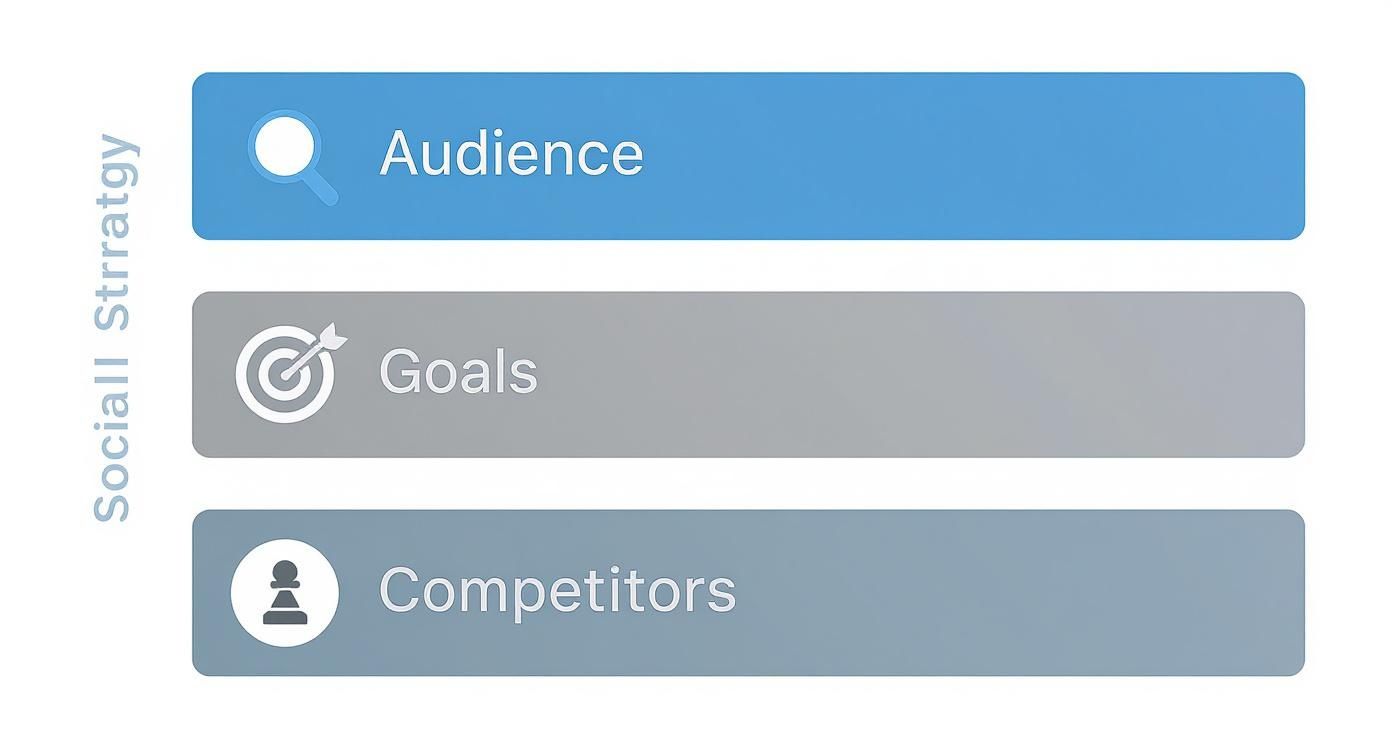
This visual really nails down the essentials. Think of audience analysis, goal setting, and competitor research as your compass for navigating the German market effectively.
The Major Players and How People Use Them
Let's look at the numbers. Recent data shows just how connected Germany is. As of early 2025, there were 65.5 million active social media user identities—that's a staggering 77.6% of the entire country. And while that figure dipped slightly from the previous year, an impressive 83.4% of all adults are still active online. This isn't just a market; it's a massive opportunity if you know where to focus. For a deeper dive, the Digital 2025 Germany report from DataReportal is a goldmine of information.
So, where is everyone? YouTube remains an absolute giant. Its advertising reach is equivalent to 77.6% of the total population, making it pretty much non-negotiable for any brand using video to connect with a wide audience.
But other platforms are making interesting moves.
Snapchat, for example, saw its ad reach grow by over 2 million users (+10.5%) between early 2024 and 2025. This is a clear signal of a growing, valuable audience, especially if your brand is trying to connect with younger Germans through visual, in-the-moment content.
Prioritising Your Efforts: Where to Play
To help you decide where to focus your resources, here's a quick overview of the main platforms and their potential in Germany.
Social Media Platform Reach in Germany (2025 Overview)
| Platform | Reach Metric | Statistic | Key Takeaway |
|---|---|---|---|
| YouTube | Ad reach vs. total population | 77.6% | The top choice for broad-reach video content. Essential for demos, tutorials, and brand stories. |
| Ad reach vs. total population (18+) | 26.1% | A powerful niche for B2B marketing, professional networking, and sharing industry expertise. | |
| Snapchat | Ad reach vs. total population (13+) | 24.5% | Experiencing significant growth, particularly with younger demographics. Ideal for ephemeral, visual content. |
| Ad reach vs. total population (13+) | 38.9% | A visual powerhouse perfect for lifestyle brands, e-commerce, and influencer collaborations. | |
| Ad reach vs. total population (13+) | 27.6% | Still a major player for community building and reaching a broad adult demographic with targeted ads. |
This table isn't just about picking the platform with the biggest number; it's about matching the platform's strengths to your business goals. A local plumbing company might find more value in a targeted Facebook community than a splashy YouTube campaign.
Crafting a Strategy for Each Platform
Just being on the right platforms isn’t enough. The content has to feel right for the space. What gets traction on a professional network like LinkedIn will likely feel awkward and out of place on a visual-first platform like Instagram. Nailing these nuances is a fundamental part of effective social media planning.
Here's how you can start to think about organising your content:
- For broad reach and product demos, YouTube is your best bet. Think tutorials, how-to guides, and brand storytelling that can capture the largest possible audience.
- For B2B and professional conversations, it has to be LinkedIn. This is the place to share industry insights, celebrate company milestones, and build genuine business relationships.
- For visual storytelling and younger audiences, Instagram and Snapchat are key. Use them for behind-the-scenes glimpses, user-generated content campaigns, and influencer partnerships that feel authentic and engaging.
By really thinking through these distinct platform dynamics, you can build a content strategy that doesn't just reach German users, but actually connects with them.
Defining Your Core Content Pillars and Themes

Alright, you’ve figured out who you’re talking to and what you want to achieve. Now for the fun part: deciding what you’re actually going to talk about. This is where you lay the creative groundwork for your entire social media presence.
Successful content creation for social media isn’t about randomly posting whatever comes to mind. The best accounts are built on a solid foundation of content pillars. These are the 3-5 core themes or topics your brand will consistently own.
Think of them as the main sections in your brand’s library. They aren’t just about your products or services; they reflect the value you offer, the expertise you share, and the personality that makes you unique. Sticking to these pillars keeps your content relevant and stops you from staring at a blank screen wondering what on earth to post next.
How to Identify Your Content Pillars
So, where do you find these pillars? They live at the intersection of what your audience cares about and what your business knows best. What are the questions your customers ask all the time? What unique knowledge can you share that no one else can? The answers to these questions are pure gold.
Let's imagine a local Berlin café. Instead of just posting pictures of lattes, they could build their strategy around a few distinct pillars:
- Speciality Coffee Education: This is where they geek out. They could explore different brewing methods, the stories behind their beans, and unique flavour profiles. This doesn't just sell coffee; it establishes them as genuine experts.
- Behind-the-Scenes Stories: People connect with people. Introducing their baristas by name, showing how their pastries are made, or sharing the journey of sourcing local ingredients builds a real, human connection.
- Community and Local Events: They could become a neighbourhood hub by highlighting local news, promoting artists whose work they display, and sharing details about events they're hosting.
See how these themes go so much deeper than just "we sell coffee"? They create a world around the brand that people actually want to be a part of.
Your content pillars are the strategic guardrails for your creativity. They give you the freedom to explore different formats and ideas while ensuring everything you post is cohesive and serves a purpose.
From Pillars to Endless Post Ideas
Once your pillars are locked in, brainstorming becomes a breeze. Each one can branch out into dozens of sub-topics and content formats. This structured approach means you're never scrambling for last-minute ideas and can build out your content calendar with confidence.
Let's take one of the café's pillars and see how it can fuel a whole stream of content. From their "Speciality Coffee Education" pillar alone, they could create:
- An Instagram Reel demonstrating the perfect pour-over technique.
- A Carousel Post breaking down the tasting notes of a new single-origin bean.
- A TikTok Video where a barista quickly debunks common coffee myths.
- A Facebook Post asking followers about their favourite way to brew coffee at home, sparking a genuine conversation in the comments.
This simple framework turns content creation for social media from a daily chore into a strategic, repeatable process. Each pillar becomes a wellspring of ideas, helping you deliver consistent value and keep your audience coming back for more.
Crafting Social Media Posts That Actually Engage

So, you’ve got your content pillars sorted. That's a huge step. But a brilliant idea is only half the battle; how you bring it to life is what really matters. This is where we get into the nuts and bolts of content creation for social media—the practical craft of building posts that stop the scroll and earn that tap, comment, or share.
It all starts with the words. Great copywriting is a blend of art and psychology. You have about three seconds to hook someone scrolling through their feed, so your opening line has to count. From there, it's about guiding them effortlessly to a clear, simple call-to-action (CTA).
Writing Copy That Connects
Your captions aren't just filler text under a picture; they’re a massive part of the experience. They add context, inject personality, and are your best chance to ask your audience to do something. Never treat them as an afterthought.
A solid social media caption usually has a few key ingredients:
- A Scroll-Stopping Hook: Lead with a question, a surprising statistic, or a problem you know your audience faces.
- Value in the Middle: This is where you deliver the goods. It could be a quick tip, a personal story, or useful info that helps your reader.
- A Crystal-Clear CTA: Tell people exactly what you want them to do next. Is it "save this post for later," "tag a friend who needs this," or "head to the link in our bio"?
This simple framework works because it respects people's time while giving them something valuable right away. If you're looking for inspiration, you can even find creative prompts showing you how to use ChatGPT for engaging Instagram content in fun, unexpected ways.
Designing Visuals That Stand Out
You don't need a fancy design degree to create visuals that pop. Sticking to some basic design principles can make all the difference. The key is consistency—use your brand’s colours, fonts, and general vibe in everything you create.
Remember, the goal of a social media visual is to get a message across instantly. A clean, uncluttered design with one clear focal point will always beat a busy, confusing one.
This is especially true in a market like Germany, where the appetite for high-quality digital content is exploding. The German digital content creation market pulled in revenues of USD 1,235.2 million in 2024 and is expected to more than double by 2030. This boom is fuelled by e-commerce, which has created a massive need for product reviews, unboxing videos, and lifestyle content that guides buying decisions.
Tailoring Your Content for Each Platform
This might be the most important part of the whole process: adapting your content to where you're posting it. A killer TikTok video will almost certainly fall flat on LinkedIn, and vice versa. Every platform has its own culture, audience expectations, and algorithm quirks.
- TikTok: It's all about short, entertaining, trend-led videos that feel raw and authentic.
- Instagram: This is a visual-first world. Think high-quality photos, polished carousels, and slick Reels.
- LinkedIn: This is where you go for professional insights, industry news, and long-form, thoughtful articles.
A successful LinkedIn post is built on expertise and deep analysis. A great TikTok is often a 15-second clip that nails a relatable feeling. Understanding these differences is what turns your content from just "being there" into something truly effective.
Building a Workflow with a Content Calendar

Consistency is the absolute bedrock of social media growth. But let's be honest, trying to conjure up fresh, brilliant ideas every single day is a surefire recipe for burnout. This is where a content calendar becomes your most valuable asset.
It’s more than just a schedule; it’s your strategic command centre. It transforms that chaotic, last-minute scramble into a smooth, predictable process. Think of it as your single source of truth for what gets published, where it goes, and when it goes live.
Planning your content creation for social media in advance gives you a crucial bird's-eye view. You can see your entire strategy laid out, making it easy to spot gaps, ensure a healthy mix of post types, and align your content with important dates or campaigns.
Choosing Your Content Calendar Tool
The "best" tool is the one you'll actually stick with. You don't need a high-end, expensive platform right out of the gate. Your choice should come down to your team's size, your budget, and how you like to work.
- Simple Spreadsheets (Google Sheets/Excel): Don't underestimate the power of a good spreadsheet. They're perfect for solo creators or small teams just getting their feet wet. You can customise them endlessly to track post topics, copy, links, and publication dates—and they’re completely free.
- Project Management Tools (Trello/Asana): If you need to manage an approval process or collaborate on visuals, these tools are a great next step. They let you track a post's journey from a rough "idea" to "published" using cards and workflows.
- Dedicated Social Media Platforms (Trustypost/Hootsuite): These are the all-in-one powerhouses. They combine your calendar with scheduling, in-depth analytics, and inbox management, giving you a complete solution for the entire social media lifecycle.
The real power of a calendar isn’t the tool itself, but the process it enables. It forces you to think ahead, batch similar tasks, and organise your creative energy efficiently, preventing the dreaded "what do I post today?" panic.
Building an Efficient Workflow
A solid workflow gets an idea from your brain to your audience's feed with as little friction as possible. One of the most effective tactics to achieve this is content batching.
Instead of doing everything for one post every day, you dedicate specific blocks of time to a single task. For example, spend a Monday morning just brainstorming a month's worth of video ideas. Then, block out a full day to film all of them in one go.
This approach is so much more efficient. It helps you get into a creative flow state and avoids the mental whiplash of constantly switching between writing, designing, and editing. Once you've batched your creation, you can focus on the next crucial piece of the puzzle: finding the best times to schedule social media posts for maximum visibility.
This kind of planning also guarantees your feed remains balanced and interesting. Use your calendar to consciously map out different types of content: posts that promote your services, content that educates and builds authority, and posts that are just plain entertaining to build community. That variety is what will keep your audience coming back for more.
Using Analytics to Refine Your Content Strategy
Putting content out on social media without ever checking your analytics is a bit like driving with your eyes closed. Sure, you're moving, but you've got no idea if you’re actually heading in the right direction. The final, and arguably most important, part of any solid social media workflow is creating a feedback loop driven by real data. This is what turns your content creation from a guessing game into a predictable engine for growth.
It all begins with getting comfortable with your analytics. Every social platform has a dashboard filled with numbers, and it's easy to get lost in them. Many people get fixated on vanity metrics like follower count. It feels great to see that number go up, but it doesn't always translate into actual business success.
What you really need to do is zero in on the numbers that signal a genuine connection and tell you what your audience truly cares about.
Focusing on Metrics That Matter
To get a real feel for your performance, you need to prioritise metrics that show how your content is truly landing with people. This means shifting your focus to data that reflects genuine interest and action. For a much deeper dive, you can learn all about choosing the right social media KPIs in our comprehensive guide.
Here are the key areas I always keep an eye on:
- Engagement Rate: This is the big one. It bundles up likes, comments, shares, and saves, showing you what percentage of people who saw your post actually interacted with it. It’s the clearest sign of how compelling your content is.
- Reach and Impressions: Reach tells you how many unique accounts saw your post. Impressions track the total number of times it was seen. If your impressions are much higher than your reach, it’s a good sign that people are looking at your content more than once.
- Website Clicks: If one of your main goals is driving traffic back to your site, this metric is non-negotiable. It’s a direct measure of how well your social media content persuades people to take that next step.
- Conversion Rate: This tracks how many people completed a specific action—like signing up for your newsletter or buying a product—after clicking from your social post. It’s the ultimate measure of ROI.
The most powerful insights come from spotting patterns. If you notice that all your top-performing posts are short, educational videos, that’s not a coincidence—it’s your audience telling you exactly what they want to see more of.
Running a Simple Content Audit
Once you know which numbers to watch, get into the habit of doing a simple content audit every month or quarter. It doesn't have to be complicated. Just look at your best and worst-performing posts from that period and start asking questions. Why did that one Reel get so many shares? What made that carousel post fall completely flat?
This process quickly shines a light on your strongest content pillars and formats. Armed with that knowledge, you can start to systematically improve your results with a bit of A/B testing. Try out different headlines, visuals, or calls-to-action on similar posts to see what moves the needle.
It's this cycle of creating, measuring, and refining that separates accounts that just tick along from those that see consistent, meaningful growth.
Your Top Social Media Content Questions, Answered
Even the most buttoned-up content plan runs into real-world questions. It’s one thing to have a strategy on paper, but it’s another to execute it day in and day out. Let's dig into some of the most common sticking points that pop up and how you can navigate them without losing momentum.
How Often Should I Be Posting?
This is the classic question, and the honest answer is: there's no single magic number. What truly matters is consistency, not just a high frequency.
It's far more effective to share three genuinely valuable, well-crafted posts each week than to scramble and push out seven mediocre ones just to fill the calendar. A huge mistake I see people make is aiming for daily posts from day one, which almost always leads to burnout.
Start with a realistic schedule you know you can stick to, maybe 3-5 times a week on your main platform. Once you’ve got a good rhythm going, you can always scale up. Remember, quality over quantity, always. Check your analytics to find out when your audience is online and active—that’s your sweet spot.
What's the Best Way to Spot New Trends?
Staying on top of trends is key to getting seen, but it doesn't have to be a full-time job. The trick is to build a small, consistent habit.
Set aside just 15 minutes each morning to simply scroll through your primary platforms like TikTok or Instagram. Don't just mindlessly consume—pay attention. What sounds are you hearing over and over? Are there specific video formats or challenges that keep popping up? You can also use social listening tools to keep an eye on keywords and hashtags in your niche, which can give you a heads-up on conversations that are starting to bubble up.
Can I Repurpose Content on Different Platforms?
Yes, you absolutely should! Repurposing is a brilliant way to get more mileage out of the hard work you’ve already put in. But—and this is a big but—never just copy and paste.
Each social media platform has its own vibe, its own culture. Simply cross-posting the exact same content everywhere feels lazy and misses the mark. Instead, think about adapting.
- Long-form Video: Got a detailed tutorial on YouTube? Chop it up into a few bite-sized, high-impact clips for Reels or TikTok.
- Blog Post: Pull the most powerful takeaways from a blog post and turn them into a slick, informative carousel for Instagram or a thoughtful discussion prompt for LinkedIn.
This approach is becoming more important than ever, especially in markets like Germany, where specialised social media content is booming. Projections show the market there is set to grow at a compound annual rate of 10.7% between 2025 and 2035. This growth is largely fuelled by small and medium-sized businesses getting creative with localised, platform-specific content. As you can see from recent market analysis on German social media trends, tailoring your content is no longer optional if you want to connect with your audience.
Stop guessing and start posting with confidence. Trustypost learns your brand's unique voice and generates daily, on-brand post ideas in minutes. Start your free 7-day trial today at https://trustypost.ai.