

Creating content for social media isn't just about posting pretty pictures. It's a deliberate process of planning, producing, and publishing posts that actually connect with people. It all comes down to defining your brand's personality, truly understanding who you're talking to, and setting clear goals so that every Reel, carousel, or simple text post has a reason for being.
Building Your Social Media Content Foundation
Jumping straight into making posts without a plan is a bit like trying to build a house without a blueprint. You might get a wall up, but it's not going to be stable. Before you even think about designing a graphic or writing a caption, you need to lay a solid foundation. This isn't about creating stuffy rules; it’s about getting crystal clear on your direction so your efforts are focused, consistent, and actually work.
This initial groundwork makes sure your content creation for social media is tied to your bigger business goals. When your voice, audience, and objectives are all singing from the same hymn sheet, every post feels authentic and purposeful. That’s how you build a real community, not just a list of followers.
Define Your Authentic Brand Voice
Your brand voice is much more than just what you say—it's how you say it. It’s the distinct personality that comes through in your captions, your videos, and even how you reply to comments. Are you witty and informal? Or are you more authoritative and educational? Ditching the generic corporate jargon is the first step to forming a genuine connection.
Think about a brand like Oatly. They have a quirky, self-aware voice that's instantly recognisable across all their platforms. It works because it feels human, not like it came from a faceless company. A great way to start is by jotting down a few adjectives that describe your brand and creating simple guidelines to keep everyone on the same page.
Identify Your Ideal Audience
You can’t create content that resonates if you don’t know who you’re creating it for. You have to go deeper than basic demographics like age and location. The real gold is in the psychographics: what are their interests, their online habits, their biggest challenges, and what are they looking for from brands like yours on social media?
A few questions to get you started:
- Where do they hang out online? Are they doomscrolling on TikTok for a laugh or are they on LinkedIn looking for career tips?
- What problems are they trying to solve? When you understand their pain points, you can create content that offers a real solution.
- What kind of posts do they actually engage with? Look at what they’re liking, sharing, and commenting on. That’s your roadmap.
This is especially critical in a market like Germany, where social media use is widespread. With 65.5 million active users—that’s 77.6% of the population—the opportunity to connect is enormous. For any business that wants to grow organically, having an organic social media marketing playbook is non-negotiable. It's particularly telling that 51% of Germans aged 16-34 use social platforms to research brands, making a well-defined audience strategy essential for shaping buying decisions.
Set Clear and Achievable Goals
Your social media activity needs to be tied to real, measurable outcomes. What are you actually trying to achieve? Posting for the sake of posting is the fastest way to burn out and waste your time. Your goals will ultimately decide the kinds of content you need to be making.
This infographic lays out the core process, from finding your voice to setting your goals.
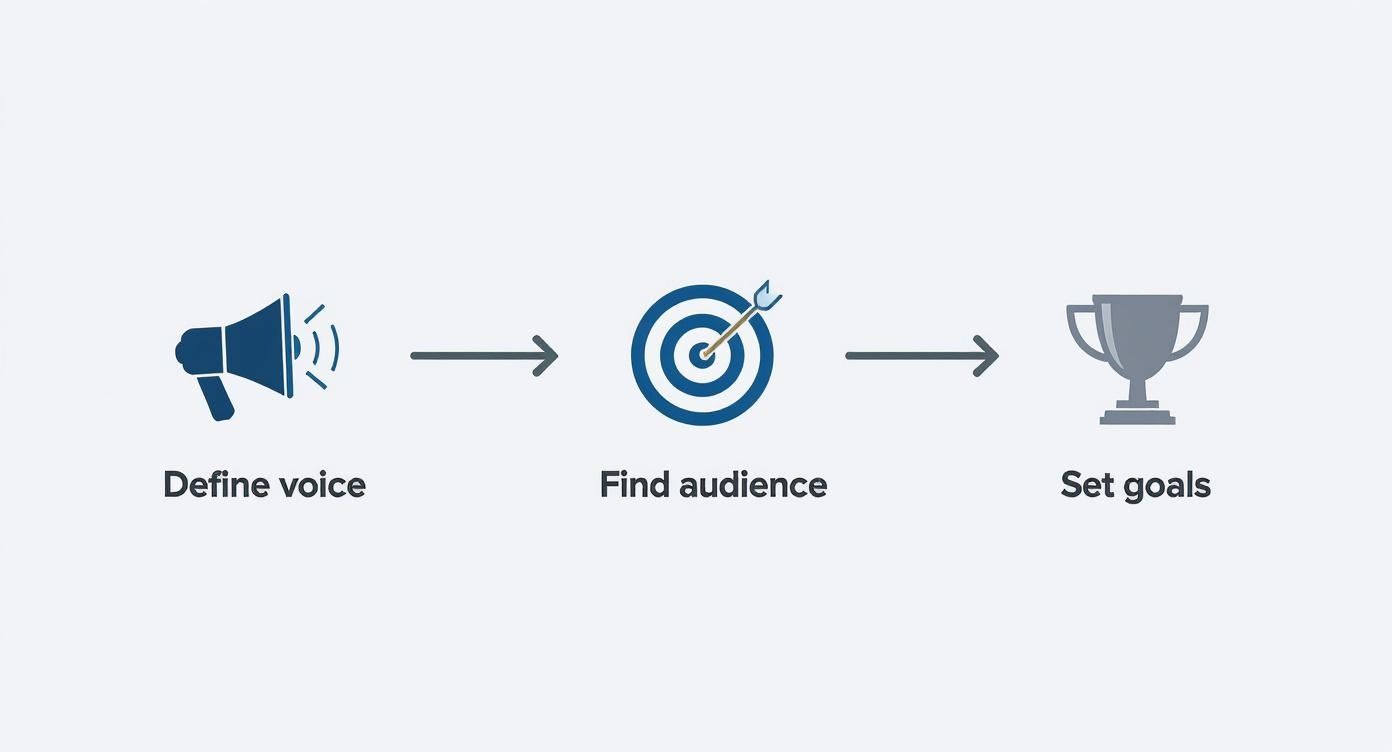
Notice how each step logically flows into the next? That’s how you build a strategy that holds together.
Some common goals might be:
- Building Brand Awareness: Getting your name out there and becoming more recognisable.
- Driving Website Traffic: Nudging followers to click through to your blog posts, product pages, or special offers.
- Generating Leads and Sales: Turning followers into actual customers with targeted content and clear calls-to-action.
- Fostering a Community: Creating a space where your biggest fans can interact with you and each other.
By setting specific, measurable, achievable, relevant, and time-bound (SMART) goals, you shift your social media from a passive chore into an active tool for growing your business. Having that clarity makes every content decision that much easier.
Once you have these foundational pieces locked in, you’re ready to move from planning to brainstorming ideas. To go even deeper into this crucial first phase, have a look at our complete guide on crafting a winning social media content strategy. This groundwork ensures that the amazing content you create won't just look good, but will also deliver real results for your brand.
Developing an Endless Stream of Content Ideas
We’ve all been there—staring at a blank content calendar, the cursor blinking mockingly. The pressure to come up with fresh, engaging posts day after day can feel relentless. But the secret isn't waiting for a lightning bolt of inspiration. It’s about building a solid, repeatable system that does the heavy lifting for you.
When you have a process in place, content creation stops being a frantic, last-minute scramble and becomes a strategic, manageable part of your routine. Let's get that system built.

Establish Your Core Content Pillars
First things first, you need a foundation. That's where content pillars come in. Think of these as the three to five core themes your brand will consistently talk about. These pillars should be the sweet spot where your expertise meets what your audience genuinely cares about, all while supporting the business goals you’ve already set.
Let’s imagine you run a local bakery. Your pillars might look something like this:
- Behind-the-Scenes Baking: Giving people a peek into the craft and passion that goes into every loaf and pastry.
- Ingredient Spotlights: Highlighting the quality of your local suppliers and educating your audience.
- Customer Stories: Sharing user-generated content of regulars enjoying your treats.
- Weekly Special Features: Building buzz and anticipation for new or limited-edition items.
Suddenly, you have a framework. Instead of asking, "What should I post today?", you can ask, "What's an interesting 'Behind-the-Scenes' story I can tell?" It’s a simple shift, but it makes brainstorming so much easier.
Tune into Your Audience with Social Listening
Your best ideas are often hiding in plain sight—in the comments, questions, and conversations your audience is already having. Social listening is simply the practice of monitoring social media for mentions of your brand, your competitors, and relevant keywords.
You don't need fancy tools to get started. Just use the native search functions on Instagram or X to see what people are talking about. Are customers constantly asking how to properly store sourdough? That's your next Reel. Are they confused about the difference between a flat white and a latte? Perfect topic for a carousel post.
When you actively listen, you stop guessing what your audience wants and start knowing what they need. That shift is the key to creating content that doesn't just get likes, but actually helps people.
Employ Proven Brainstorming Techniques
With your pillars defined and your ears open, it’s time to fill that calendar. Structured brainstorming isn't about locking yourself in a room and hoping for magic; it’s about using proven creative exercises to get the ideas flowing.
Mind Mapping: Grab a pen and paper (or a digital tool) and put one of your content pillars in the centre. From there, just start branching out. Jot down related sub-topics, common questions, different formats—anything that comes to mind. You'll be surprised how this visual approach helps you spot new connections and angles.
Competitive Gap Analysis: Take a good look at what your competitors are doing. But don't just focus on what they do well; look for what they aren't doing. If their feeds are full of polished, perfect product shots, maybe there's an opening for you to share the messy, authentic, behind-the-scenes reality. Finding those gaps is how you carve out a unique voice. For more specific ideas, our guide on Instagram Story inspiration can give you some fresh perspectives.
And remember, one of the most powerful ways to keep the content flowing is to get smart about how to repurpose content. A single blog post can become a dozen different social media updates. This approach ensures you’re never truly starting from scratch again.
Creating Social Content That Actually Connects
You've got your strategy mapped out and a solid list of ideas. Now for the fun part: actually making the content. This is where your plans and brainstorms become real, tangible posts that stop people from scrolling and start genuine conversations.
It's all about pairing the right tools with the right creative approach to produce content that truly connects, not just fills a slot in your calendar. And you don't need a Hollywood budget or a massive production team to do it. Some of today's most engaging content is shot on a smartphone, fuelled by a clear understanding of what makes people tick. Authenticity and value are your real secret weapons here.
Assembling Your Creative Toolkit
Having a go-to set of tools is non-negotiable for creating quality content without burning out. The great news is you don't need to splurge on complex, expensive software. The modern creator's toolkit is more accessible and user-friendly than ever—and often free.
This reliance on good tech is a massive trend. In Germany, the digital content creation market is booming, with revenues projected to jump from USD 1,235.2 million in 2024 to an incredible USD 2,650.1 million by 2030. What's really telling is that the "tools" segment—the software and apps—made up over 80% of this market in 2024. This shows just how critical the right technology has become. You can dive deeper into these insights about the German content market on Grandview Research.
Here are a few essentials that belong in every social media manager’s back pocket:
- For Graphic Design: Canva is the undisputed champion for non-designers. It's packed with thousands of templates for everything from Instagram Stories to LinkedIn banners, letting you create professional-looking graphics in minutes.
- For Mobile Video Editing: Apps like CapCut and InShot have put surprisingly powerful editing suites right on our phones. You can easily trim clips, add text overlays, find trending audio, and apply effects to produce polished videos ready for any platform.
- For High-Quality Stock Media: When you need a specific image or video clip you can't shoot yourself, sites like Pexels and Unsplash are lifesavers. They offer huge libraries of free, high-resolution photos and videos.
Crafting Captions That Spark Conversation
A stunning visual might stop the scroll, but it's the caption that seals the deal and drives engagement. So many brands treat captions as an afterthought, simply describing the photo or making a dull announcement. That’s a huge missed opportunity. Your caption is your chance to add personality, ask questions, and get people talking.
Instead of just stating facts, try telling a mini-story or sharing a relatable insight. A great trick is to end your captions with an open-ended question to encourage comments. For instance, instead of, "Here's our new coffee blend," try something more human: "That first sip of coffee on a Monday morning is pure magic. What's your go-to ritual to start the week?" This small shift turns a broadcast into a conversation starter.
The goal of a caption isn't just to inform; it's to make your audience feel seen and heard. Treat it like the start of a conversation, not a broadcast from a megaphone.
Tailoring One Idea for Multiple Formats
Working smart in content creation means you don't have to constantly reinvent the wheel. The real pros take one strong idea and skilfully adapt it across different platforms and formats. This content repurposing strategy saves a ton of time and energy while getting your message in front of more people.
Let's imagine you wrote a blog post on "Five Ways to Improve Your Home Office." That single piece of content is gold—it can easily be spun into a whole week's worth of social media posts.
Here’s one way you could break it down:
- Instagram Reel: Create a fast-paced video showing quick cuts of all five tips in action, set to a trending audio track.
- Instagram Carousel: Design a multi-slide post where each slide breaks down one of the five tips with a great photo and bite-sized text.
- LinkedIn Post: Write a more professional, text-focused post on the productivity benefits of just one specific tip, sharing a personal story about how it helped you.
- TikTok Series: Film a separate short video for each of the five tips, turning it into a mini-series that gets viewers to follow along for the next part.
By tailoring the format, you're respecting the unique culture and user expectations of each platform. This makes your content feel native and natural, no matter where your audience finds it. Ultimately, creating content that actually connects is a mix of being authentic and having a smart, repeatable workflow.
Putting Your Scheduling on Autopilot
Look, creating amazing content is one thing. Getting it in front of people at the right time, consistently, is a whole different ball game. If your posting is erratic or happens when your audience is asleep, all that hard work might go unnoticed. This is where a smart scheduling workflow stops you from scrambling every day and turns social media into a calm, proactive process.
Consistency really is the secret sauce for social media growth, and a well-oiled scheduling system is what keeps the engine running. This isn't about giving you more work; it’s about freeing up your time and mental energy so your brand stays top-of-mind without you feeling the daily pressure to post.
Find a Scheduling Tool That Works for You
Manually posting every single piece of content across all your platforms is a direct path to burnout. Scheduling tools are lifesavers here. They automate that final step, letting you focus on the creative side and engaging with your community. Think of them as a personal assistant, publishing your posts at the perfect times, even when you’re offline.
There's a huge range of tools out there. Some are massive, all-in-one platforms, while others are more straightforward schedulers. Many, like Trustypost, even help with idea generation and writing the copy itself.
When you're shopping around, here's what you should look for:
- One Dashboard to Rule Them All: You need to be able to manage all your important social profiles from one place. It’s a non-negotiable.
- Smart Timing Suggestions: The best tools don't just post; they analyse when your audience is most active and suggest the optimal times to publish for maximum impact.
- A Visual Content Calendar: Seeing your whole schedule laid out visually is a game-changer. A drag-and-drop calendar makes it easy to spot gaps and ensure you have a good mix of content.
- Built-in Analytics: Great tools close the loop by showing you what’s performing well. This data is gold for refining your strategy over time.
Figure Out Your Posting Rhythm
"How often should I post?" It’s the question every social media manager asks. The truth is, there’s no magic number. It's all about finding a rhythm that is sustainable for you. Quality always, always beats quantity. Posting three genuinely valuable updates a week is infinitely better than seven rushed, forgettable ones.
Use these as a starting point, but let your analytics be your ultimate guide:
- Instagram: 3-5 times per week
- Facebook: 1-2 times per day
- LinkedIn: 1-2 times per day
- TikTok: 3-5 times per week
These aren't strict rules, just guidelines. The real key is to be consistent. If your audience gets used to hearing from you every day, they'll definitely notice if you vanish for a week. Pick a frequency you can realistically stick to without your content quality taking a nosedive.
Burnout is a real danger in the creator world, often fuelled by the pressure to be constantly "on." A sustainable workflow isn't just a smart business move; it's an essential act of self-care to protect your creative energy for the long run.
Discover the Magic of Batching Your Content
If you make one change to your workflow, make it this one. Content batching is the single most effective way to reclaim your sanity. Instead of living in a constant cycle of creating and posting every day, you set aside a dedicated block of time to create a week’s—or even a month’s—worth of content all at once.
It’s just like meal prepping. You put in the effort upfront so that during the busy week, everything is sorted. The exact same principle applies to social media content creation.
A simple batching process could look something like this:
- Ideation Session: Block out a few hours to brainstorm all your ideas for the month, tying them back to your content pillars.
- Creation Day: Dedicate a full or half-day to the "doing"—write all the captions, design the graphics, and edit the videos. Get it all done.
- Scheduling Blitz: Set aside one hour to upload everything into your scheduling tool, double-check the timing for each post, and hit "schedule."
This approach pulls you out of the daily reactive chaos. It lets you sink into a deep, creative flow state without the constant distraction of switching between tasks. By building a solid workflow on the right tools, a sustainable pace, and the power of batching, you guarantee your brilliant content actually gets the attention it deserves.
Measuring What Works (and Ditching What Doesn’t)
You wouldn't shout into an empty room, right? Well, creating content without checking the results is pretty much the same thing. After all that work planning, creating, and scheduling, this is where the magic really happens. We need to dig into the data and figure out what actually resonated with our audience so we can do more of it.
Think of it as a constant conversation. You post, you listen to what the analytics tell you, and then you refine your next move. This feedback loop is what turns guesswork into a smart, effective strategy that gets better over time.

Find the KPIs That Actually Matter
Before you can measure success, you have to define what it looks like for your brand. A post that gets a thousand likes is nice, but if your goal was to drive website traffic and it generated zero clicks, it wasn't a success. It was just a distraction.
The key performance indicators (KPIs) you track must connect directly back to the goals you set from the very beginning.
To help you focus on what's important, here’s a quick breakdown of which metrics to track based on your primary objective. This table helps you avoid vanity metrics and measure what truly matters for your business.
| Goal | Primary KPI | Secondary KPI | Example Platform Tool |
|---|---|---|---|
| Brand Awareness | Reach | Impressions | Facebook Page Insights |
| Engagement | Engagement Rate | Comments | Instagram Insights |
| Website Traffic | Click-Through Rate (CTR) | Landing Page Views | LinkedIn Analytics |
| Sales/Leads | Conversion Rate | Cost Per Conversion | Meta Ads Manager |
This clarity helps you concentrate your creative energy on content that actually moves the needle. If you want to dive deeper, our guide on which social media KPIs are most important is a great next read.
Get to Know Each Platform’s Native Analytics
You don’t need to splash out on expensive tools straight away. Every major social platform has its own free, built-in analytics dashboard, and they are packed with valuable information. Seriously, these are your new best friends.
For instance, Instagram Insights can tell you the age, location, and even the exact hours your followers are most active. For B2B brands, LinkedIn Analytics offers incredible data on the job titles of people engaging with your content. Take an afternoon to properly explore these dashboards. They’re designed to help you win on their platform.
Make a Content Review a Regular Habit
Data is only useful if you do something with it. I recommend setting aside time every month—or at least every quarter—to do a proper content review. You’re not just looking at spreadsheets; you’re looking for the story behind the numbers.
During this review, ask yourself these questions:
- Which content pillars really took off? Did the "Behind-the-Scenes" posts crush the "Product Spotlights"?
- What formats are people loving? Are your Reels getting all the attention while static images are falling flat?
- What was the secret sauce in our top posts? Was it a specific tone, a type of visual, or a particular topic?
- What completely flopped? Be honest. Knowing what didn't work is just as valuable as knowing what did. Don't be afraid to stop doing something if the data shows your audience isn't interested.
This consistent review process is what separates brands that feel stuck from those that are constantly improving. It’s your chance to pause, reflect, and make sure your strategy is always getting smarter.
This agile approach is becoming crucial, especially for smaller businesses. In Germany, for example, it's projected that small and medium-sized enterprises (SMEs) will account for 61.8% of the social media market's revenue in 2025. They’re not competing with huge budgets; they're competing with creativity and a deep understanding of their audience. You can discover more insights about the social media market on Future Market Insights to see this trend in action.
By regularly refining your strategy based on performance, you ensure your voice isn’t just heard—it’s the one that people listen to.
Your Top Social Media Content Questions, Answered
Even with the perfect strategy on paper, the day-to-day reality of creating social media content can throw some curveballs. When you're in the thick of it, questions always pop up. I’ve been there. Let’s tackle some of the most common hurdles I see people face so you can get back to creating with confidence.
How Often Should I Really Be Posting?
This is the million-dollar question, isn't it? But the truth is, there's no magic number that works for everyone. The single most important thing to remember is that consistency always, always trumps frequency.
It’s far better to publish three genuinely brilliant, engaging posts a week than it is to churn out ten mediocre ones just to hit a quota. Your audience will notice the drop in quality, and your engagement will suffer for it.
If you’re just looking for a sensible starting point, here’s a rough guide:
- Instagram: Aim for 3-5 times a week.
- Facebook & LinkedIn: 1-2 times a day often works well.
- TikTok: The algorithm favours activity, so try for 3-5 times a week to stay top-of-mind.
But let me be clear: these are just baseline suggestions. The real answer is hiding in your analytics. Dive into your platform’s built-in tools and find out when your audience is most active. Let their behaviour, and your own capacity to create great stuff without burning out, be your true guide.
What Are the Best Free Tools for Creating Content?
You absolutely do not need a massive budget to create scroll-stopping content. In fact, some of the most powerful and flexible tools I use are either completely free or have free versions that are more than enough to get the job done.
Here’s my go-to, no-cost creative toolkit:
- For Polished Graphics: Canva is still the undisputed champion here. The sheer volume of templates for every format you can imagine means you can create something that looks professionally designed in minutes.
- For On-the-Go Video Editing: I'm a big fan of CapCut and InShot. Both are incredibly intuitive mobile apps that pack a serious punch with their editing features.
- For High-Quality Stock Media: When you need a photo or video clip that doesn't scream "stock," your first stops should be Pexels and Unsplash. Their libraries are massive, beautiful, and royalty-free.
Remember, the quality of your content is a reflection of your creativity and how well you know your audience, not the price tag of your software. Get comfortable with these free tools, and you’ll build a fantastic foundation.
I'm Stuck. How Do I Find New Content Ideas?
Creator’s block is real, and it’s frustrating. When the well of ideas feels completely dry, the worst thing you can do is stare at a blinking cursor. The trick is to stop looking inward for inspiration and start looking outward.
First, go listen to what people are actually talking about. Use social listening—search for relevant keywords and hashtags in your niche. What questions are people asking? What problems are they trying to solve? That’s your content right there.
Next, do a little friendly competitor analysis. Check out their top-performing posts from the last few months. I'm not saying you should copy them, but you should absolutely look for the topics that are clearly hitting the mark with the audience you both share.
Finally, look at your own archives. That blog post you poured your heart into last month? It's a goldmine. You can easily spin it into an Instagram carousel, a series of short video clips for TikTok, and a thought-provoking text post for LinkedIn. This way, you're never truly starting from a blank page.
Should I Be Using AI to Create My Social Media Content?
This is a hot topic right now. AI can be a phenomenal assistant in your creative process, but it should never be the final author. Think of it as a tool to supercharge your own creativity, not replace it entirely.
I like to use AI as a brainstorming partner. It's brilliant for generating a list of potential topics, outlining a carousel, or even drafting a few caption ideas to get me past that initial writer's block.
But here’s the non-negotiable part: you must always review, edit, and inject your brand's unique personality and voice into anything an AI spits out. Your audience can spot generic, robotic copy from a mile away, and it's a fast way to lose their trust.
The smartest way to approach AI is as an accelerator for your workflow, not a substitute for the human strategy and genuine authenticity that builds a real connection with people.
Ready to make your social media content creation feel effortless? Trustypost is your AI-powered ghostwriter and scheduler, learning your brand's voice to generate daily, on-brand post ideas. Start your 7-day free trial today and turn your social media presence into a powerful tool for growth. Learn more at https://trustypost.ai.