
If you want to grow your business on LinkedIn, the very first thing you need to do is stop thinking of your profile as a digital résumé. It’s not. It’s a dynamic, client-facing tool that should act as a magnet for your ideal customers. This is the bedrock of your entire strategy, and it's where you build immediate trust and showcase exactly what you bring to the table.
Build Your Foundation for LinkedIn Growth
Before you even think about outreach, content, or lead generation, your digital presence needs to be solid. A lot of businesses spin their wheels on LinkedIn because their profiles are either half-finished or just a list of accomplishments. You need to flip the script. Your profile should be a hub that instantly answers your visitor's biggest question: "What's in it for me?"
Optimise Your Personal Profile First
Here’s a simple truth: people connect with people, not logos. That makes your personal profile the most powerful tool in your arsenal for building genuine relationships.
Your headline is prime real estate. Don't waste it with a generic job title. Instead of "CEO at Company X," try something like, "I Help SaaS Founders Scale Revenue with Strategic Content Marketing." See the difference? One is a title; the other is a value proposition. It immediately tells visitors who you help and how.
Then, carry that narrative into your summary section. This is your chance to tell a story. Talk about the problems you solve for your clients and the incredible results you deliver. Keep it scannable with short paragraphs and bullet points that highlight your key services or client outcomes.
Strengthen Your Company Page
While your personal profile builds relationships, your Company Page is what legitimises your business. It’s your brand’s central hub, a place to house content and build authority. LinkedIn’s own data shows that companies with complete, regularly updated pages get up to 30% more weekly views.
Getting this right goes beyond just filling in the blanks. You can dive deeper with our complete guide on creating a business page on LinkedIn, but here are a few things you absolutely must do:
- Weave in Keywords: Think about what terms your ideal clients are searching for. Sprinkle these keywords naturally throughout your tagline and "About" section to show up in more searches.
- Add a Clear Call-to-Action: Don't make people guess what to do next. Customise that button at the top of your page to send them to your website, a demo sign-up, or a helpful resource.
- Spotlight Your Services: Use the dedicated "Services" feature to clearly list what you offer. This makes it incredibly easy for potential clients to see how you can solve their problems.
Your LinkedIn profile is often the first handshake you have with a potential client or partner. Make sure it's a firm one. Treat your profile like a digital storefront—it needs to be clean, informative, and inviting.
To make this process straightforward, I've put together a checklist to guide you. Run through these points to ensure your profile is primed for growth.
LinkedIn Profile Optimization Checklist
This quick checklist covers the essentials for transforming your LinkedIn profile from a simple CV into a powerful business-generating asset.
| Profile Element | Optimization Action | Why It Matters for Growth |
|---|---|---|
| Profile Photo | Use a professional, high-resolution headshot where you look approachable. | Builds instant trust and recognition. People connect with faces, not blank spaces. |
| Banner Image | Create a custom banner that reflects your brand, value proposition, or a call-to-action. | This is your digital billboard. Use it to communicate value immediately. |
| Headline | Craft a client-focused headline that explains who you help and the results you provide. | The single most important element for grabbing attention in search results and feeds. |
| "About" Summary | Tell a compelling story. Focus on client problems and your solutions. Use bullet points. | This is your sales pitch. A strong summary convinces visitors to engage further. |
| Featured Section | Pin your best content: a lead magnet, a case study, a key article, or your website. | Directs traffic to your most valuable assets and showcases your expertise. |
| Experience | Detail your roles with a focus on accomplishments and results, not just duties. Use metrics. | Provides social proof and demonstrates a track record of success. |
| Recommendations | Actively request and give genuine recommendations from clients and colleagues. | Third-party validation is far more powerful than self-promotion. |
By working through this list, you're not just "filling out a profile"—you're building a strategic foundation.
Ultimately, your personal and company profiles need to work together. Your personal profile starts the conversation, and your polished Company Page provides the social proof and corporate credibility to help seal the deal. When you get this combination right, you're well on your way to mastering LinkedIn marketing.
Develop a Content Strategy That Resonates
A killer profile is a fantastic start, but it's just the launchpad. To really get your business moving on LinkedIn, you need a solid content strategy that consistently delivers value and cements your reputation as an expert. Without one, even a perfectly polished profile will just sit there, struggling to get noticed. Your aim is to shift from being just another connection to becoming the go-to resource in your industry.
This requires a fundamental change in how you think about your content. Stop selling and start educating. Your posts should be the solution to your ideal client’s most urgent problems and burning questions. Think about it: when you consistently solve small issues for them with your free content, they’ll naturally start trusting you to handle their bigger challenges with your paid services.
Define Your Core Content Pillars
Posting whatever pops into your head on any given day is a recipe for a scattered message. Instead, build your expertise around three to five core content pillars. These are the big-picture topics you want to be known for—your signature themes.
Let's say you're a financial advisor who specialises in helping tech start-ups. Your pillars might look something like this:
- Founder-Friendly Fundraising
- Scaling Financial Operations
- Tax Optimisation for Growth
- Personal Wealth Management for Entrepreneurs
Now, every single piece of content you create should tie back to one of these pillars. This approach does two things brilliantly: it builds a strong, cohesive brand identity and teaches your audience exactly what kind of value they can expect from you, reinforcing your specific expertise with every single post.
Mix Your Content Formats
Nobody wants to see the same thing over and over. Keeping your audience engaged means mixing things up. Using different content formats helps you appeal to different learning styles and, just as importantly, stops people from scrolling right past your posts. While a well-written, text-only post can be incredibly powerful for storytelling, visual content is often what grabs their attention in the first place.
Try to work a blend of these formats into your weekly plan:
- Text-Only Posts: Fantastic for sharing personal anecdotes, quick industry hot-takes, or asking questions that get people thinking.
- Single-Image Posts: A powerful image, a revealing screenshot, or a simple graphic can make your point far more memorable.
- Carousels (PDFs): These are absolute gold for breaking down complex ideas into easy-to-follow, step-by-step guides or handy checklists.
- Short-Form Video: A great way to share quick tips, offer a behind-the-scenes look at your work, or give a bite-sized summary of a bigger piece of content.
Don't just post content; start conversations. Always try to end your posts with an open-ended question to encourage comments and get a dialogue going. That engagement is pure rocket fuel for the LinkedIn algorithm.
Create and Schedule Consistently
Let’s be clear: consistency trumps frequency every time. It’s far better to post high-value content two or three times a week than to push out mediocre stuff every single day. The goal is to build a rhythm, a reliable habit for your audience. You want them to start anticipating your insights.
Professionals are on LinkedIn actively searching for valuable information. It’s no surprise that research shows posts with genuine, in-depth insights get the highest engagement, and long-form content tends to get way more shares and comments.
To keep this up without burning yourself out, a simple content calendar is your best friend. Map out your topics and formats a week or two ahead of time. This organised approach doesn't just save you stress; it ensures you’re strategically hitting all your content pillars. For some deeper advice on writing great content, take a look at our guide on creating an effective LinkedIn post.
Engage Your Team to Amplify Your Reach
Your employees are your single greatest, and most overlooked, asset on LinkedIn. It’s a common mistake for businesses to pour all their energy into their Company Page while ignoring the incredible reach of their team's combined networks. If you want to see real growth, you need to mobilise your people. This is how you transform your brand from a lone voice into a powerful chorus.

This isn’t about forcing your team to spam their connections. It's about building a simple, organised employee advocacy programme that encourages them to get involved. When your team shares company updates, their networks see it, instantly putting your brand in front of audiences you could never reach alone. That kind of authentic engagement builds trust and credibility like nothing else.
Make Participation Effortless
Let's be honest, the biggest hurdle to employee advocacy is usually just friction. Your team might be thinking, "What should I say?" or "When is the best time to post?" Maybe they're not even sure what they're allowed to share. Your job is to make it ridiculously easy for them.
A great starting point is a shared resource—think a Google Doc or a dedicated Slack channel—filled with pre-approved content. This makes sharing a two-minute job, not a creative chore.
Here’s what you could include:
- Ready-to-share updates: Short, punchy text snippets about company news, recent blog posts, or team achievements. They can just copy, paste, and post.
- Branded visuals: A folder of high-quality images, graphics, or short videos that are on-brand and ready to go.
- Suggested commentary: Provide a few different prompts or questions they can add to make the post feel more personal.
By providing the building blocks, you remove the guesswork and empower them to become confident brand ambassadors without adding a major task to their day.
Showcase Your People to Humanise Your Brand
A truly effective advocacy programme isn't just about pushing out company announcements. It's about empowering your team to build their own professional brands, which naturally boosts your company's profile in the process. Encourage them to share their unique insights, weigh in on industry trends, and talk about their day-to-day work.
People connect with people, not logos. When your team members share their expertise and passion, they humanise your brand, making it more approachable, relatable, and trustworthy.
This creates a brilliant win-win. Your employee strengthens their professional reputation and network, and your business benefits from genuine, expert-driven content. Think about it: when one of your engineers shares a deep technical insight or a project manager details a successful client collaboration, it showcases the talent in your organisation far more powerfully than any corporate press release ever could.
This employee-led activity is the secret to unlocking massive growth. Research consistently shows that when businesses post content, 30% of the engagement comes directly from their employees. What's more, employees are 14 times more likely to share company content than anyone else, which puts your message on a whole new level. You can dig into more LinkedIn statistics to see just how powerful this can be for your business strategy.
Master Strategic Networking and Community Building
Real growth on LinkedIn doesn’t come from passively racking up contacts. It’s about building genuine connections. You need to shift your mindset from pure quantity to quality, focusing on relationships that actually lead to partnerships, referrals, and new business.
This strategic approach turns your network from a digital address book into a powerful community asset.
It all starts by identifying the right people to connect with. Think bigger than just potential clients. Who are the influencers and movers in your industry? Pinpoint key decision-makers, potential strategic partners, and respected thought leaders. A smart connection strategy is your first real step towards growing your business on LinkedIn.
Crafting Connection Requests That Actually Work
Let's be honest, the generic "I'd like to connect with you on LinkedIn" message is the digital equivalent of a weak handshake. It’s forgettable and, frankly, lazy. To get noticed, you have to personalise your request and show you’ve put in a tiny bit of effort.
Before you even think about clicking "Connect," engage with their recent content. Drop a thoughtful comment on a post they shared or an article they wrote. Then, when you send the request, mention that specific interaction.
Try something like this:
- "Hi [Name], I really enjoyed your recent article on [Topic]. Your point about [Specific Detail] was particularly insightful. I’d love to connect and follow your work."
This little bit of context shows you have a genuine interest. It proves you value their expertise, not just another number on your connections list, and it dramatically boosts your chances of them accepting.
A personalised connection request isn't just a tactic to get accepted; it's about starting a relationship on the right foot. You're setting the stage for a real conversation, not a one-sided sales pitch.
Nurturing Relationships in LinkedIn Groups
Beyond individual connections, LinkedIn Groups are goldmines for building a community. These are dedicated forums where you can engage with professionals in your niche, share what you know, and build up your visibility. The secret? Participate, don't just promote.
Find a handful of active groups that are relevant to your industry and make a commitment to engage regularly. Don't just dump links to your own stuff and run. Instead, answer questions, offer helpful advice, and get involved in the conversations already happening.
By doing this, you position yourself as a helpful resource, not just another person trying to sell something. Our detailed guide on how to effectively search on LinkedIn can help you find the most relevant groups and decision-makers for your business.
When you consistently provide value without asking for anything back, you build trust and authority. Sooner or later, when someone in that community has a need, they'll remember the expert who was always there to help. This long-game strategy of giving first is what transforms simple connections into genuine business opportunities.
Convert Connections into Business Opportunities
Getting a big network of connections is one thing, but it’s only half the battle. The real magic happens when you turn those relationships into actual business. This is where you gently shift from conversation to conversion, and the key is to do it without losing the trust you’ve worked so hard to build.
Let's be clear: a hard sales pitch is the fastest way to get ignored or, worse, removed as a connection. Nobody is on LinkedIn to be sold to. Instead, you need to become a master at spotting opportunities to genuinely help.
Keep a close eye on what your connections are posting and talking about. Are they mentioning a business challenge you know how to solve? Did they just announce a new project that fits perfectly with what you offer? These moments are your green light to start a more meaningful conversation.
A great way to take the next step is by suggesting a chat offline. After you’ve had a few good back-and-forths in the comments or DMs, you can propose a quick call.
The trick is to frame it as a value exchange, not a sales ambush. You could say something like, "I've really enjoyed our chat about [Topic]. I have a few other ideas that could be useful for your new project. Would you be open to a quick 15-minute chat next week to run through them?" This shows you respect their time and positions you as a helpful resource, not a pushy salesperson.
Nurturing Leads Systematically
To do this effectively without letting great opportunities fall through the cracks, you need a system. This doesn't mean you need complicated software—it can be as simple as a spreadsheet to track your most promising conversations and where each person is in your pipeline.
The path from a new connection to a solid lead is a journey. It's all about finding the right people, connecting in a human way, and then carefully nurturing that relationship.
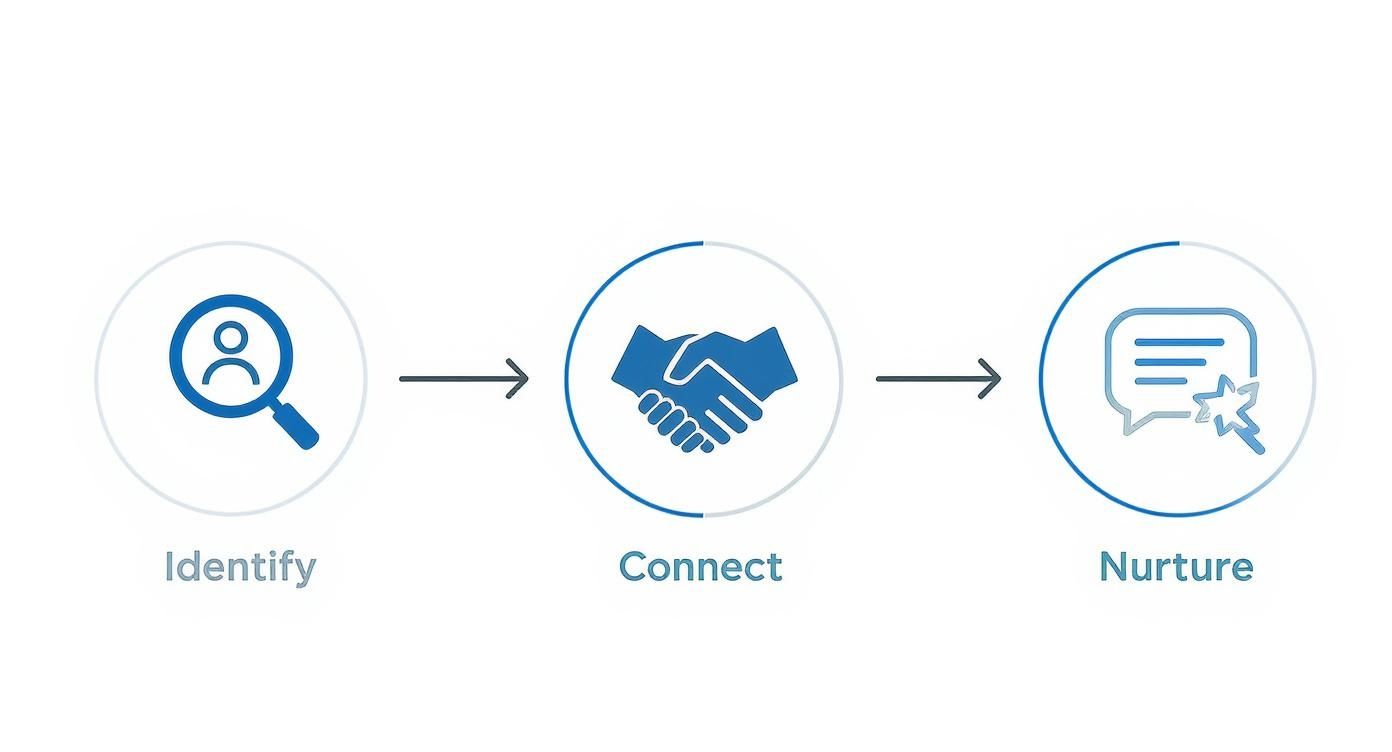
This process really highlights why patience is so important. Each stage builds on the last, creating a solid foundation of trust before you ever start talking about business.
If you’re ready to get more serious about lead generation, tools like LinkedIn Sales Navigator can be a game-changer. It gives you powerful search filters, lets you build targeted lead lists, and helps you keep track of decision-makers at your dream companies. It helps you move from just reacting to opportunities to proactively finding them. To really take things to the next level, it's worth diving into how to acquire high-ticket clients on LinkedIn.
The secret to converting connections on LinkedIn is timing. Your aim is to be the first person they think of when a problem you can solve pops up. That only happens if you’ve been consistently adding value and building a genuine relationship long before they’re ready to buy.
The Journey from Conversation to Client
Let's break down what this looks like in the real world. Imagine you're a marketing consultant. You see a connection—let’s say she's the Head of Marketing at a tech start-up—post about her team's struggle to get qualified leads from their company blog.
Here’s your playbook:
-
Engage in Public First: Don’t just "like" the post. Leave a genuinely helpful comment with a specific tip. Something like, "Have you tried optimising your top-performing articles with more targeted CTAs? We saw a 20% lift in qualified leads for a similar client by doing just that." This showcases your expertise to everyone.
-
Then, Move to Private: Once she replies to your comment, follow up with a DM. "Glad that tip was helpful! I've actually got a quick checklist I put together for content conversion that I'd be happy to share. No strings attached."
-
Finally, Offer the Call: After you've sent the resource and she's thanked you, it's time to make your move. It’s a soft offer, not a demand. "If you'd like to brainstorm how some of those ideas could apply to your specific situation, I'm free for a quick call on Thursday."
This patient, value-first approach builds trust at every single step. By the time you suggest a call, it feels like the natural next step in a helpful conversation, not a sudden sales pitch.
To give you a clearer picture, here’s a simple breakdown of how you can think about the lead nurturing journey on LinkedIn.
Lead Nurturing Stages on LinkedIn
Each connection can be thought of as being in a different stage of a relationship with you. Your job is to guide them from one to the next by consistently providing value.
| Stage | Key Actions | Goal |
|---|---|---|
| New Connection | Personalise your connection request and send a brief, non-salesy welcome message. | Establish a positive first impression and open a line of communication. |
| Warm Contact | Engage with their content (likes, comments), share relevant articles, and check in occasionally via DM. | Build familiarity and position yourself as a helpful expert in your field. |
| Engaged Prospect | Identify a specific need or pain point from their posts or conversations. Offer a valuable resource like a guide or checklist. | Provide direct value and demonstrate your ability to solve their problems. |
| Qualified Lead | After providing value, suggest a brief call to discuss their specific challenges in more detail. | Move the conversation offline to explore a potential business fit. |
Thinking about your network in this structured way helps ensure you’re always building relationships, not just collecting contacts.
A Few Common Questions About Growing on LinkedIn
As you start putting these strategies into practice, you're bound to run into a few common questions. Getting your footing on LinkedIn can feel a bit tricky at first, but a few core principles can help cut through the noise and keep you focused on what actually moves the needle.
Let's tackle some of the hurdles I see businesses face most often.
How Much Time Do I Really Need to Spend on LinkedIn Every Week?
Here’s the good news: you don’t have to live on the platform to see real results. But you do need to be consistent. I always recommend aiming for 3-5 hours per week, but the secret is breaking that time down into daily, focused sessions of about 30-45 minutes. A little bit of effort every day is so much more powerful than a frantic, once-a-week scramble.
What should you do in that daily window? Keep it simple and high-impact:
- Share one genuinely helpful piece of content.
- Jump into the comments on posts from key connections or in your favourite groups.
- Send out 5-10 connection requests, but make each one personal.
- Reply to any messages or comments you've received.
This kind of routine keeps you visible and builds momentum without completely taking over your schedule.
What are the Most Important Numbers to Track?
It’s incredibly easy to get caught up in vanity metrics. Likes and follower counts feel good, but they don't pay the bills. The key is to focus on the numbers that actually signal you're moving closer to your business goals.
My rule of thumb is this: if you can't draw a straight line from a metric to a potential client conversation, it's not worth obsessing over.
Instead, keep an eye on these performance indicators:
- Profile Views: Are more of the right people checking you out? This tells you if your profile tweaks and content are working.
- Connection Growth: More specifically, is your network growing with people who fit your ideal client profile? Quality over quantity, always.
- Engagement on Your Posts: I pay far more attention to comments and shares than likes. They show your content is actually sparking a conversation.
- Conversations Taken Off-Platform: This is the big one. How many chats are moving from LinkedIn DMs to an email or a call? That’s your ultimate success metric.
Should I Use My Personal Profile or My Company Page?
This is a big one, and my answer is always the same: focus on your personal profile. People connect with people, not logos. Especially in the B2B space, relationships are built on trust and personality, and your personal profile is where that happens. It's your stage for sharing insights, showing who you are, and starting real conversations.
So, what’s the point of a Company Page? Think of it as your business’s official headquarters. It’s the place for company-wide news, a complete list of your services, and a central hub for your team to rally around. It plays an important supporting role, but the real engine for your growth on LinkedIn will always be the authentic activity coming from the personal profiles of you and your team.
Ready to take the guesswork out of your LinkedIn content? With Trustypost, you can generate on-brand post ideas, create stunning visuals, and schedule everything in minutes. Stop the content grind and start building relationships that matter. Begin your free 7-day trial today and see how simple consistent, high-quality social media can be.