

Hiring a social media management freelancer is so much more than just handing off your posting schedule. Think of it as bringing on a strategic partner, someone whose job it is to grow your brand’s digital presence in a meaningful way. The secret to making this work? You have to move past vague goals like ‘more engagement’ and get crystal clear on your business objectives before you even start looking.
Defining Your Social Media Goals Before You Hire
Before you can find the right person, you need a map. It’s a classic mistake to jump straight into hiring without first defining what success actually looks like for your business. This almost always leads to mismatched expectations and, frankly, disappointing results.
A great place to start is with a quick audit of your current social media. What’s working? Where are the obvious gaps? This isn’t just about follower counts. Look deeper. Which platforms actually drive traffic to your website? What kind of content truly connects with your audience? Where do your ideal customers hang out online? This initial review gives you a solid baseline to build from.
Translating Business Needs into Measurable KPIs
Once you have that baseline, you can start turning broad business needs into specific, measurable Key Performance Indicators (KPIs). This is probably the most important part of creating a job brief that will attract the best talent. Instead of just asking for “better content,” you need to define what that actually means for your bottom line.
To get your business goals ready for a freelancer, use a checklist like this one. It’s designed to help you turn high-level needs into a clear brief that a potential partner can understand and execute on.
Your Freelancer Requirement Checklist
| Area of Need | Key Questions to Ask Yourself | Example Goal |
|---|---|---|
| Brand Awareness | Do we need more people to know who we are? How do we measure “reach”? | “Grow our share of voice on X (formerly Twitter) for key industry topics by 10%.” |
| Lead Generation | Is social media a channel for new business? What does a “qualified lead” look like? | “Increase qualified leads from LinkedIn by 20% within the next quarter.” |
| E-commerce Sales | Can we directly link social activity to sales? Which platform is best for this? | “Boost e-commerce sales attributed to Instagram ads by 15% month-over-month.” |
| Community Engagement | Do we want a more active, loyal community? What actions signify engagement? | “Increase comment-to-like ratio on Instagram posts by 5% to foster more conversation.” |
This simple exercise ensures you’re hiring for results, not just for activity. You’ll be able to communicate exactly what you need, and a great freelancer will know immediately if they have the skills to deliver.
Setting clear, data-driven goals empowers a freelancer to act as a true strategist, not just an order-taker. It completely shifts the conversation from tasks to outcomes, making sure you’re both pulling in the same direction.
This is the foundational step in any successful social media strategy, as the infographic below illustrates.
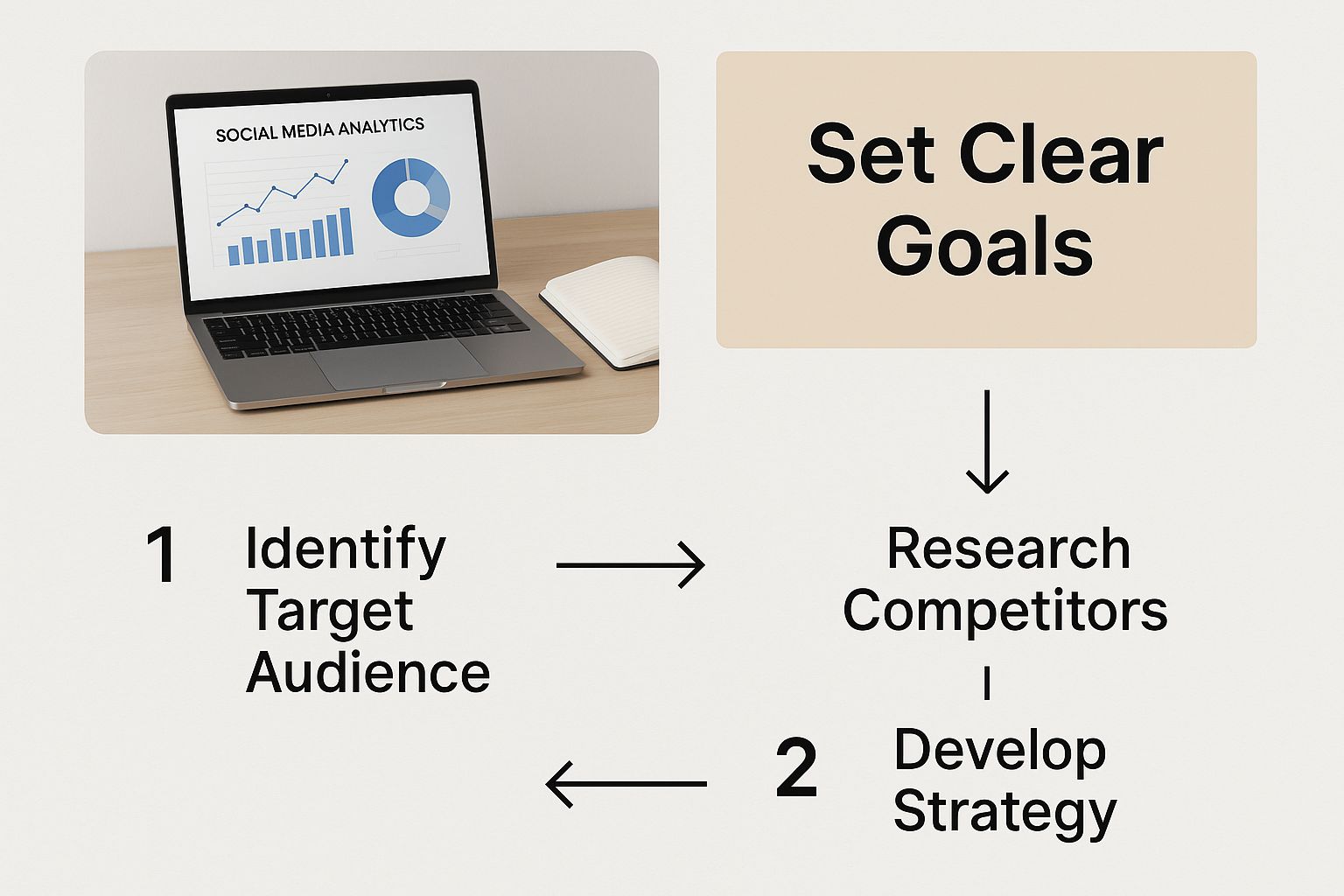
As the image shows, clear objectives, backed by data, are at the heart of effective social media management. For instance, in the German market, a massive 85% of B2B marketers see LinkedIn as delivering the highest ROI, which makes freelancers with deep LinkedIn expertise incredibly valuable. You can find more stats like this on a platform like Hootsuite. If you need more help with this, you can also explore our guide on setting the right social media KPIs.
Alright, you’ve got your brief nailed down. Now, where do you actually find these social media wizards? The talent pool is massive, so knowing the right places to look is half the battle.
Let’s start with the most obvious spots: specialised freelance marketplaces. Sites like Upwork and Fiverr Pro are go-to platforms for a reason. They’re fantastic for finding pre-vetted talent, especially if you have a specific, project-based task in mind. You can sift through detailed profiles, check out their past work in portfolios, and read reviews from other clients, which really helps with that initial screening. To get the most out of these sites, it helps to understand their differences so you can choose the best freelance platform for your specific needs.

Go Beyond the Job Boards
If you’re looking for someone to become a more strategic, long-term part of your team, you might need to dig a little deeper. Professional networks are goldmines for this. LinkedIn, for instance, isn’t just a place to post a job and wait. Use it to actively hunt for people with the exact industry experience you need. You can see their career history, how they talk about their work, and how they engage with others. This is often how you find those hidden gems—the passive candidates who aren’t actively job hunting but are perfect for the role.
And don’t forget one of the most powerful, yet underused, tactics: your own network.
Referrals from trusted colleagues are frequently the fastest and most reliable path to hiring a great freelancer. You get the benefit of a pre-vetted candidate who has already proven their worth to someone you know.
Seriously, just ask. Post in your industry-specific Slack channels or Facebook groups. Ping a few professional contacts. You’ll be surprised at the quality of recommendations you get.
The move toward freelance talent is no small trend. In Germany, for example, a solid 30% of Fortune 500 companies now tap into freelance platforms. Small and medium-sized businesses are right there with them. This is being driven by the freelancers themselves, too. A staggering 81% of European freelancers say that managing their own schedule is their top priority, making them an incredibly flexible and motivated resource for any business.
Wherever you end up searching, make your job post count. Be incredibly specific about the role, crystal clear on the skills you need, and upfront about your budget. That kind of transparency is what attracts top-tier professionals who are ready to jump in and deliver results.
Vetting Candidates and Portfolios Like a Pro

Finding freelancers is the easy part. Choosing the right one? That’s where the real work begins. Your inbox might be flooded with people who seem great on paper, but now it’s time to sift through the noise and find a genuine strategist, not just someone who can post a pretty picture.
Think of this vetting stage as your most crucial line of defence against a bad hire.
First up, their portfolio. Don’t let yourself be distracted by slick graphics and a perfectly curated feed. You need to dig deeper and look for the results behind the content. A truly great portfolio doesn’t just show you what they made; it proves what they accomplished for their clients.
Looking for Real Impact in Their Case Studies
This is where you separate the pros from the amateurs. A portfolio full of random Instagram posts is a warning sign. What you’re really looking for are case studies that tell a complete story, backed by data.
A solid case study should walk you through:
- The Client’s Problem: What specific challenge were they trying to solve?
- Their Strategic Plan: How did the freelancer propose to tackle that problem?
- The Work Itself: What did the actual content, ads, or community engagement look like?
- The Outcome: What metrics actually moved the needle? Ignore vanity metrics like ‘likes’. You want to see hard numbers on things like lead generation, conversion rates, and real audience growth.
If you see a lot of style but no substance, be wary. You’re hiring someone to help grow your business, not just to make your grid look nice. This is what separates a top-tier strategic social media ghostwriter from a basic content creator—they get the business goals behind every single post.
Asking Questions That Reveal True Expertise
The interview is your chance to really get inside their head. Ditch the generic questions like “Are you creative?”. Instead, throw them some curveballs—situational questions that force them to show you how they think on their feet.
The best interview questions reveal how a candidate thinks, not just what they know. Focus on their process for handling both success and failure to get a true measure of their expertise and resilience.
Try asking things like:
- “Walk me through a campaign that didn’t go as planned. What did you learn, and what would you do differently today?” This shows you if they can analyse data, own their mistakes, and actually learn from them.
- “Looking at our business, how would you adapt your usual approach to fit our specific target audience?” This immediately tells you if they’ve done their homework on your company.
- “What’s your exact process for putting together a monthly content calendar from scratch?” This gives you a clear window into their organisational skills and how they plan ahead.
When in doubt, a small, paid trial project is the ultimate test run. Giving a candidate a real task allows you to see their skills, communication, and work ethic firsthand before you sign a long-term contract. It’s the best way to be sure you’ve found the right fit.
Getting the Paperwork and Pay Right
So you’ve found someone who looks like a great fit. Fantastic! Now comes the crucial part: making it official. This is where you talk money and draw up a contract that protects everyone involved. Getting this right from the start is the foundation of a good working relationship.
Let’s tackle compensation first. Freelancer rates can seem a bit like the Wild West, but they typically follow one of three main structures. Knowing the difference will help you put together a fair offer that works for your budget and the job at hand.
- Hourly Rates: This is a good option for work that ebbs and flows, like ongoing community management or creating content as needed. You only pay for the time they actually spend working.
- Project-Based Fees: Perfect for self-contained tasks with a definite start and finish. Think a specific product launch campaign or a one-off social media audit.
- Monthly Retainers: This is the go-to for most long-term social media management. You agree on a fixed fee each month for a clearly defined list of services. It gives you predictable costs and provides the freelancer with stable income.
What Goes Into a Solid Contract?
A contract isn’t just about the money; it’s the blueprint for how you’ll work together. Trust me, skipping this step often leads to confusion and headaches later on.
A good contract should spell everything out, leaving no room for guesswork. Make sure you cover:
- Scope of Work: Be ridiculously specific. List every single task, from the number of posts per platform each week to the format of the monthly performance report.
- Payment Terms: How much, when, and how? State the rate, when invoices will be sent, and your preferred payment method.
- Content Ownership: A simple but vital clause. It should state that once you’ve paid for the content, it belongs to your business.
- Communication: How will you stay in touch? Set clear expectations for response times and define your main channels, whether it’s Slack, email, or something else.
A detailed contract isn’t about a lack of trust; it’s about creating clarity. It protects both of you from ‘scope creep’ and ensures you’re both on the same page from the get-go.
For a bit of context, in Germany, the average full-time freelancer invoices around €63,000 annually. This figure gives you a decent benchmark when you’re thinking about fair compensation. Of course, specialists with in-demand skills, like paid advertising or deep analytics, will often be at the higher end of that scale. You can find more detailed info on freelancer earnings in Germany to help you structure a competitive offer.
Onboarding Your Freelancer for Immediate Impact
You’ve signed the contract. Great! But don’t pop the champagne just yet. The real work of building a successful partnership starts now, and it all hinges on a solid onboarding process.
A sloppy, disorganised start is a recipe for missed deadlines, off-brand posts, and a whole lot of frustration. Taking the time to properly onboard your new social media management freelancer is what sets them up to start delivering real value from day one.
The goal here is simple: get them up to speed, fast.
Building an Effective Onboarding Kit
I’ve found the best way to do this is by creating a simple “brand-in-a-box” or onboarding kit. This isn’t about creating more work for yourself; it’s about creating a single source of truth they can refer back to. It also shows you’re an organised, professional client, which builds trust right from the get-go.
Your kit doesn’t need to be fancy, but it absolutely must be thorough.
Here’s what to include:
- Brand Guidelines: This is non-negotiable. Logos, colour palettes, fonts, and, most crucially, your brand’s specific tone of voice. How do you sound? Are you witty? Professional? A bit cheeky?
- Audience Personas: Who are you actually talking to? Give them detailed profiles of your ideal customers. What keeps them up at night? What are their goals and where do they hang out online?
- Tool Access: Get them set up with logins for all your social media accounts, scheduling tools like Buffer or Later, and any analytics platforms they’ll need to track performance.
- Content Examples: Don’t just show them what worked in the past—explain why it worked. Was it the humour? The relatable problem it solved? This context is gold.
A strong onboarding process empowers your freelancer to act with confidence and creativity. By giving them clear guardrails and a deep understanding of your brand, you’re not just delegating tasks—you’re enabling strategic thinking.
Finally, you need a roadmap for the first few months. Set clear, realistic expectations for the first 30, 60, and 90 days. What does success look like in each of those periods?
Agree on how you’ll communicate—a shared Slack channel is often perfect—and when you’ll connect, like a quick 15-minute check-in call each week. Decide on a reporting schedule upfront.
This structure, combined with a killer onboarding kit, ensures your new hire can dive right in and start building an effective social media content strategy that actually moves the needle for your business.
Still Have a Few Questions? Let’s Clear Them Up
Even with the best plan in place, hiring a freelancer for the first time can feel a bit daunting. You’ve probably got a few “what if” scenarios running through your mind. That’s completely normal. Let’s walk through a couple of the most common concerns I hear from business owners.
How Do I Know I’m Getting My Money’s Worth?
This is the big one, isn’t it? You’re investing your hard-earned cash and you need to see a return. The trick is to stop thinking about social media in terms of vanity metrics and start connecting it to your actual business goals.
Forget just counting likes and followers. A great freelancer’s impact should be visible in the numbers that matter to your bottom line.
Are you seeing a 15% increase in website traffic coming directly from Instagram? Is your email list growing because of a targeted Facebook campaign? That’s your ROI. You have to connect their work to tangible business outcomes.
When you frame it like this, hiring a freelancer stops being an expense and becomes a strategic investment in your company’s growth.
What if They Don’t Get Our Brand Voice?
This is a totally fair question. Your brand’s voice is its personality, and you don’t want a stranger to get it wrong.
This is exactly why a thorough onboarding process is non-negotiable. You can’t expect them to read your mind. Give them a detailed brand guide, clear examples of what you love (and what you don’t), and a deep dive into who your ideal customer is.
To get a clearer picture of the value a dedicated expert brings, you can explore the benefits of hiring a social media manager and see how they can transform your marketing.
Remember, a top-tier social media management freelancer wants to become a seamless part of your team. Their success is your success. A great way to test the waters is to start with a small, paid trial project. It gives you both a chance to see if the chemistry is right before you dive into a long-term contract. It’s the single best way to ensure they can capture your brand’s unique spark.
Ready to create consistent, on-brand content without the grind? Trustypost learns your unique voice and generates daily, platform-specific post ideas in minutes. Start your free 7-day trial today at https://trustypost.ai.