

At its heart, thought leadership is the practice of earning trust by consistently sharing unique, insightful, and forward-thinking ideas. It isn't just about being an expert; it's about shaping the conversation in your industry, helping people solve real problems, and offering them a new way to see the world.
What Is Thought Leadership, Really?

It’s easy to mix up being a thought leader with simply being an expert. While expertise is absolutely the foundation, true thought leadership takes it a significant step further.
Think of it this way: an expert knows the answers to today’s questions. A thought leader is already exploring the questions of tomorrow.
A subject matter expert is like a skilled navigator who can expertly read an existing map. But a thought leader? They’re the cartographer drawing the map for everyone else who is venturing into new territory. They don’t just report on trends; they anticipate, and often, they influence them.
Thought Leader vs Subject Matter Expert
The line between an expert and a thought leader can feel a bit blurry, but the distinction is crucial. One informs, the other inspires and reshapes thinking.
Let's break down the key differences in a simple table.
| Characteristic | Subject Matter Expert (SME) | Thought Leader |
|---|---|---|
| Focus | Knowing and explaining "what is" | Exploring and envisioning "what if" |
| Knowledge | Deep expertise in a specific domain | Uses expertise to connect dots and generate new ideas |
| Communication | Answers questions and provides facts | Asks new questions and challenges the status quo |
| Goal | To inform and be a reliable resource | To inspire and provoke new ways of thinking |
| Audience Impact | Educates the audience | Transforms the audience's perspective |
While an SME is an invaluable source of knowledge, a thought leader uses that knowledge as a launchpad for innovation and industry-wide change.
The Core Components of Authentic Thought Leadership
Genuine influence isn't about having the most followers or the loudest voice online. It’s built on a bedrock of credibility, originality, and a sincere desire to help and educate others.
A thought leader’s value isn't just in what they know, but in how they make others think. Their primary goal is to elevate the industry, not just their own profile.
So, to truly grasp what is thought leadership, you have to see it as more than a marketing tactic you can just switch on and off. It’s a long-term commitment to a particular mindset and a consistent set of actions.
This requires a real dedication to continuous learning and a willingness to share your insights freely. For a deeper look at how this works in practice, exploring programs like the Aspen Thought Leadership initiatives can be incredibly insightful.
In this guide, we'll unpack how all these elements come together to build a platform of genuine influence. We’re going to move past the buzzwords to give you a clear, actionable framework for developing your own unique voice.
The Three Pillars of Powerful Thought Leadership

Genuine influence isn’t something that happens by accident or overnight. Real thought leadership rests on three core pillars, and they all have to work together to build a voice that people respect and actively seek out.
If any of these foundational elements are missing, any attempt to establish yourself as an authority will feel hollow and won't last. Getting to grips with each one is the first step toward building a platform that truly connects with an audience and starts shaping industry conversations.
Pillar 1: Deep Expertise
The first and most crucial pillar is deep expertise. This is the non-negotiable bedrock. It's what earns you the right to have an opinion that people should listen to. Put simply, it’s the "thought" in thought leadership.
This isn't about book smarts or qualifications on a bit of paper. We're talking about proven, hands-on experience. It’s the kind of wisdom that only comes from years in the trenches, from seeing what works and, just as importantly, what doesn't. You can't lead the thinking in a field you don't understand inside and out.
Your expertise is your currency. It’s what gives your unique perspective weight and your communication its impact. Without it, you are simply adding to the noise.
Think of it like the foundation of a skyscraper. Without a deep, solid footing, whatever you try to build on top is always at risk of collapse. Your expertise needs to be just as solid.
Pillar 2: A Unique Perspective
Once that foundation of expertise is in place, the next pillar is developing a unique perspective. This is what sets you apart from every other expert out there. It’s not enough to just know what everyone else knows; you need to offer a fresh way of looking at things.
This might mean you’re:
- Challenging the Status Quo: Calling out long-held assumptions or "best practices" that have passed their sell-by date.
- Connecting Disparate Ideas: Finding clever links between different fields or concepts to spark brand-new solutions.
- Identifying Future Trends: Looking over the horizon to predict what’s coming next and helping your audience get ready for it.
Your unique point of view is your signature. It's the lens you use to interpret your expertise, which is what makes your insights feel original and stick in people's minds. This is how you go from being just another knowledgeable person to a genuine leader.
Pillar 3: Consistent Communication
The final pillar is consistent communication. Even the most brilliant ideas and unique perspectives are useless if they stay locked in your head. You have to get out there and share your insights with your audience, regularly and reliably.
Consistency is what builds momentum and trust. When people know they can count on you for regular, valuable content, they're far more likely to follow you, engage with your ideas, and view you as their go-to resource. This doesn't mean you have to be shouting from the rooftops on every platform, but you do need a sustainable plan for sharing your knowledge where your audience actually spends their time.
Get these three pillars—expertise, perspective, and communication—working together, and you've built a powerful, lasting platform. It’s the real answer to the question of what is thought leadership and how to actually achieve it.
How Thought Leadership Drives Business Growth
Let’s be clear: thought leadership isn't just a fancy term for personal branding. It's a powerful, direct engine for growing your business. When you consistently share valuable, forward-thinking insights, you’re not just building a reputation—you’re creating a strategic asset that delivers tangible returns.
The first thing you’ll notice is a deep, foundational trust taking root. When potential customers see your organisation as the go-to source for reliable information, they're far more likely to trust what you sell. This trust translates directly into a stronger brand and, ultimately, more revenue.
Speeding Up Sales and Attracting Top Talent
Insightful content completely changes the dynamic of a sales conversation. Forget the hard sell. Instead, you're educating prospects, helping them understand their own challenges better, and naturally positioning your company as the solution. This educational approach can dramatically shorten the sales cycle because leads come to you already informed and confident in your expertise.
It also acts as a magnet for top talent. High-performers want to work for companies shaping the future of their industry. When your company is seen as a hub of innovation and expertise, you’ll find the best and brightest minds wanting to join you.
Thought leadership creates a competitive moat that is difficult for others to replicate. While competitors can copy features or pricing, they cannot easily copy your reputation for insight and authority.
Creating High-Value Opportunities
This established authority opens doors that would otherwise remain closed. Suddenly, you'll find yourself presented with opportunities like:
- Strategic Partnerships: Other industry leaders will want to collaborate, leading to new ventures and market access.
- Media Coverage: Journalists and media outlets will start seeking out your opinions, giving you valuable, earned media placements.
- Speaking Engagements: Invitations to speak at major industry events will roll in, further cementing your status as an influential voice.
To really dig into how this can be used for business expansion, check out a complete guide to marketing thought leadership for B2B growth. This kind of strategic content is at the heart of building a brand that commands respect. For more on this, have a look at our guide on how to build your brand.
In Germany, this connection is increasingly seen as vital for long-term growth, especially within leadership development. The European leadership development market is projected to skyrocket from USD 17.6 billion in 2025 to USD 42.4 billion by 2035. This surge reflects a growing demand for leaders who can navigate complex business challenges—a skill that thought leadership directly cultivates. You can find more insights on the European leadership development market on futuremarketinsights.com.
Your Step-by-Step Thought Leadership Strategy
Turning your hard-won expertise into real influence doesn’t just happen. You need a plan. Knowing your stuff is one thing, but you need a structured way to get your unique perspective out into the world. Let’s walk through a practical, step-by-step roadmap to get you from a great idea to consistent, impactful execution.
This whole process is about building a bridge between trust, brand identity, and ultimately, revenue.
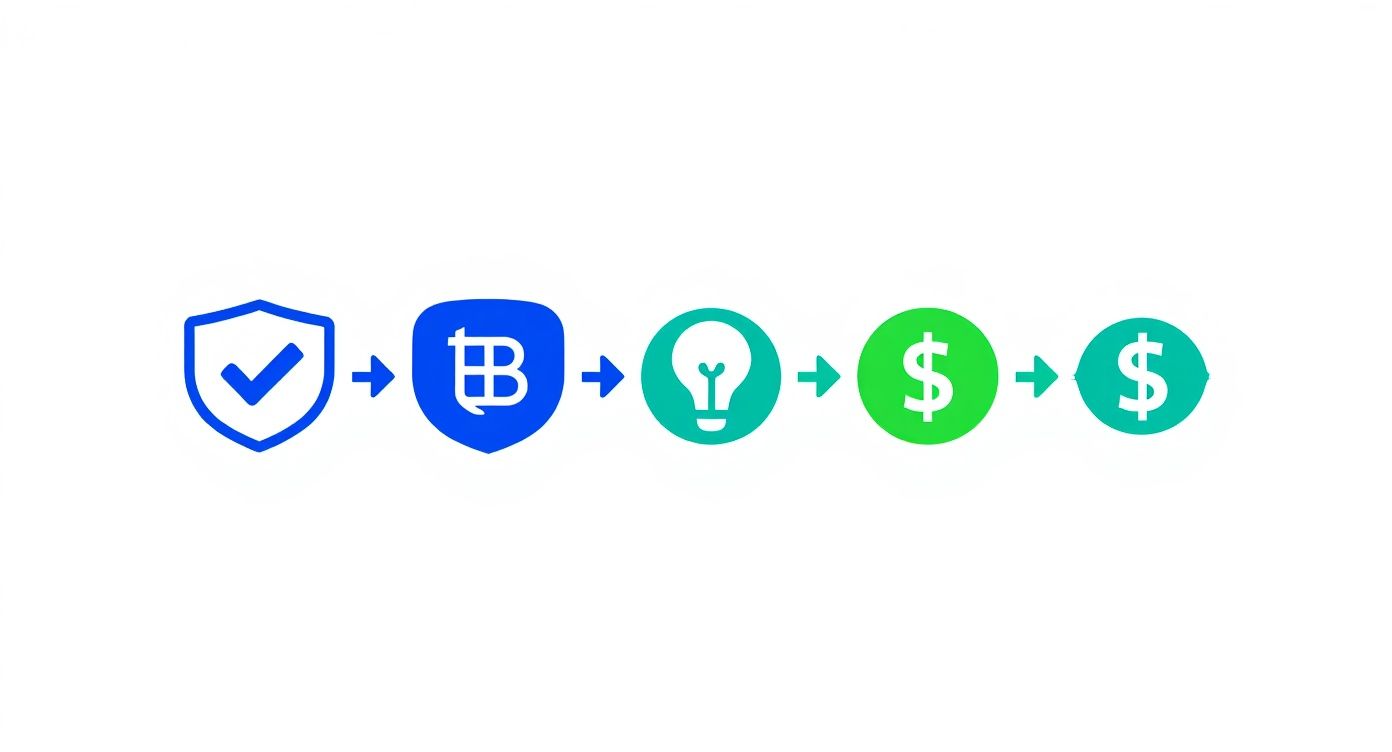
As you can see, it all starts with trust. Earn that, and you build a brand that drives real business results.
Step 1: Identify Your Niche
Before you can lead a conversation, you have to know which one you want to lead. Your niche sits at the sweet spot where your passion, your proven expertise, and a genuine audience need all meet. Spreading yourself too thin is the fastest way to get lost in the noise.
Take a moment and ask yourself a few honest questions:
- Where have I achieved real, measurable results?
- What topics do I talk about with genuine energy and excitement?
- What specific area could I truly become the go-to expert for?
Answering these questions helps you carve out a space where you can offer something nobody else can. The goal isn't to be a small fish in a big pond; it's to be a big fish in a well-defined one.
Step 2: Define Your Audience and Their Pain Points
You can't be a leader without people who want to follow. To earn that attention, you need to get inside their heads. Understand their goals, their challenges, and most importantly, what keeps them up at night.
Your content needs to be the answer to their problems. When you provide solutions and clarity, you stop being just another voice and become an indispensable resource. Your insights should feel like they were written specifically for them.
A successful thought leadership strategy is built on empathy. It starts not with what you want to say, but with what your audience needs to hear.
Step 3: Craft Your Core Message
Okay, so you have your niche and you know your audience. Now it's time to figure out what you're actually going to say. Your core message is your unique point of view—the central idea that ties all your content together. It’s what you stand for.
This message needs to be clear, concise, and compelling. It’s the one thing you want people to remember long after they’ve moved on. Think of it as the mission statement for your personal brand.
Step 4: Choose Your Content Platforms
Where does your audience hang out online? That’s exactly where you need to be. Trying to post everywhere at once is a surefire recipe for burnout. Instead, pick one or two platforms where you can truly make an impact.
To help you decide, think about where your message will land best.
Your Content Platform Options
| Platform | Primary Content Format | Best For Audience | Effort Level |
|---|---|---|---|
| Blog | Long-form articles, guides, case studies | Readers looking for in-depth, searchable answers | Medium to High |
| Short posts, articles, carousels, video | B2B professionals, industry peers, potential clients | Low to Medium | |
| Podcast | Audio interviews, solo commentary | Commuters, multi-taskers, those who prefer listening | High |
| YouTube | How-to videos, tutorials, vlogs, interviews | Visual learners, audiences seeking demonstrations | High |
| X (Twitter) | Short updates, threads, quick insights | People who want real-time news and quick takes | Low |
Choosing the right channels is non-negotiable. To really nail down your approach, our guide on building a social media content strategy has some great tips.
Step 5: Develop a Sustainable Content Calendar
Consistency is everything. Sporadic posts won't build momentum or earn you the trust you're after. This is where a content calendar becomes your best friend, helping you plan your content and stick to a regular schedule.
It doesn’t need to be complicated. A simple spreadsheet outlining your topics, formats, and publishing dates is all you need to start. The trick is to create a realistic schedule you can actually maintain for the long haul. This turns your big-picture strategy into a simple, repeatable habit.
Learning from Real-World Thought Leaders
The theory behind thought leadership is great, but seeing it in action is what really makes the light bulb go on. When we look at how real people and companies build their influence, we can start to connect the dots and see what actually works. These examples show how a unique point of view, when shared consistently, can genuinely shape an industry.
Think about a common scenario: a tech CEO who wants to be at the forefront of the conversation on sustainable manufacturing. They could just talk about their own products, but a true thought leader goes broader. They use platforms like LinkedIn to share insightful articles about new materials, revolutionary production methods, and what the future of ethical supply chains looks like.
This CEO isn't just promoting their company; they're educating an entire community. They quickly become the person you think of when you want to know what’s happening in that space, whether you're an engineer or an investor. This is the essence of thought leadership: creating value that goes far beyond your own commercial interests. For a deep dive into this approach, our guide on how to grow on LinkedIn offers some fantastic, actionable steps.
The Financial Expert and Data-Driven Reports
Let's switch gears and look at a financial services firm trying to establish its authority. The easy route is to run ads about their services. The smart route? A thought leadership approach. Instead of advertising, they invest time and resources into creating a comprehensive, data-heavy annual report on market trends.
This report isn’t a sales pitch in disguise. It’s filled with original research, sharp analysis, and bold predictions designed to help their audience make better, more informed decisions. After a few years, this report becomes an industry staple that people look forward to.
What have they really accomplished with this? Quite a lot, actually:
- Credibility: Their name is now linked directly to market intelligence.
- Influence: Journalists and other experts start quoting their findings.
- Trust: Potential clients view them as a genuine advisor, not just another vendor trying to make a sale.
A well-executed thought leadership strategy transforms your expertise from a service you sell into a resource people seek. It’s about giving your best ideas away to build a reputation that money can’t buy.
This isn't just about feeling good, either; this approach has real economic value. Take Germany’s highly specialised professional fields, where the influence of thought leaders—often called Key Opinion Leaders (KOLs)—is meticulously structured. In cardiology, for instance, there are established fair-market compensation rates for German KOLs based on their influence over scientific and commercial developments, with different tiers for local, national, and international experts.
This system puts a number on the immense value of expert influence in guiding innovation and policy. You can find more insights on these German KOL compensation rates on businesswire.com. It’s clear proof that building influence is a direct path to tangible, measurable results.
Common Mistakes to Avoid on Your Journey
The road to becoming a recognised thought leader is littered with potential missteps. Knowing what these are ahead of time is the best way to steer clear of them, keeping your strategy on track and making sure your hard work builds real influence, not just more digital noise.
One of the biggest traps is making it all about you. It’s easy to fall into the habit of talking up your own products or patting yourself on the back, but that’s not what this is about. Real thought leadership is about educating your audience and giving them the tools to succeed. Your number one job is to solve their problems, not to sell them something.
Another classic error is creating cookie-cutter content. So many aspiring leaders just end up re-hashing what everyone else is already saying. That approach completely misses the point. Your audience is searching for fresh insights and a unique point of view, not the same old ideas repackaged.
Lacking Quality and Consistency
Being inconsistent is a sure-fire way to lose momentum. Publishing one amazing article and then disappearing for six months just won't cut it. Your audience needs to see you as a steady, reliable source of quality information. Without that regular presence, you’ll never build the kind of trust that underpins true leadership.
But perhaps the most critical mistake is skimping on quality. Think about it: decision-makers are drowning in content every single day, so their standards are incredibly high. This is especially true in places like Germany, where trust and quality are everything. A recent study found that a massive 85 percent of decision-makers feel most thought leadership content is just fluff, lacking any real insight. At the same time, 89 percent said that high-quality content absolutely improves how they see a brand. You can dig deeper into these findings on how German CEOs are changing their growth strategy on kpmg.com.
The message couldn't be clearer: the bar for genuinely insightful and relevant expertise is exceptionally high. If your content doesn't bring something distinct and valuable to the table, it’s going to get ignored.
So, how do you avoid these common pitfalls? Focus on these three things:
- Put Your Audience First: Before you create anything, always ask yourself: "How does this actually help my audience?"
- Find Your Unique Angle: Don’t just repeat the headlines. Your job is to interpret what’s happening and offer a perspective that only you can.
- Commit to a Rhythm: Set up a content schedule you can realistically stick to. Consistency is the bedrock of trust.
Got Questions About Thought Leadership? We’ve Got Answers.
We get asked a lot about the nitty-gritty of thought leadership. Here are some of the most common questions that pop up, along with some straightforward answers.
How Long Does It Take to Become a Thought Leader?
This is the big one, isn't it? The honest answer is that there’s no finish line. Becoming a recognised expert isn't something you achieve and then check off a list; it’s an ongoing journey.
Generally, you’re looking at a commitment of several years of consistent, high-quality work to build a solid reputation. The secret isn't a magic timeline but a relentless focus on delivering real value and engaging with your community day in and day out.
Can a Company Be a Thought Leader, or Is It Just for People?
Absolutely, it can be both! An individual builds a personal brand around their unique insights and experience. A company, on the other hand, often earns its thought leadership stripes by publishing groundbreaking original research, in-depth reports, and valuable industry analysis.
The most powerful strategies often combine the two. Think about it: when you showcase the brilliant minds within your organisation, you naturally lift the company's reputation as a whole.
At the end of the day, thought leadership is about the power and originality of the idea itself. It doesn't matter if it comes from a person or a brand—the goal is to become the trusted, go-to source people turn to first.
Do I Need a Huge Social Media Following to Be a Thought Leader?
Not at all. While a massive following can certainly help spread your message, it’s not the be-all and end-all. What truly matters is the quality and engagement of your audience.
Think of it this way: a small, dedicated community of people who hang on your every word is far more valuable than a huge, silent crowd. Your focus should be on building real connections with the right people, not just chasing vanity metrics.
Ready to build your thought leadership platform without the burnout? Trustypost is an AI-powered social media ghostwriter that helps you create consistent, on-brand content in just minutes. Start your free 7-day trial and turn your expertise into influence today.