Think of a social media planner as the mission control for your brand's online presence. It's a tool that takes the chaos of last-minute posting and transforms it into a smooth, strategic operation. By organising and automating your content schedule across different platforms, it helps you stay consistent, save a huge amount of time, and make sure every post is working towards your marketing goals.
Why a Social Media Planner Is Your Marketing Blueprint
Ever tried to build a house without a blueprint? You might end up with four walls and a roof, but the result would be disorganised, inefficient, and probably a bit wobbly. Managing social media without a planner creates that same kind of digital chaos. You find yourself posting on the fly, missing golden opportunities, and struggling to tell a clear story about your brand.
A social media planner is that essential blueprint for your online presence. It provides the structure and foresight you need to build something strong and effective. It's the difference between waking up and thinking, "Oh no, what should I post today?" and executing a plan where every piece of content has a clear purpose. This shift is what turns social media from a daily chore into a real engine for business growth.
Solving Critical Marketing Problems
At its heart, a planner is built to solve the nagging problems that trip up marketers and business owners every single day. It brings a sense of calm and order to a task that can easily feel overwhelming.
Here are the key problems a planner takes off your plate:
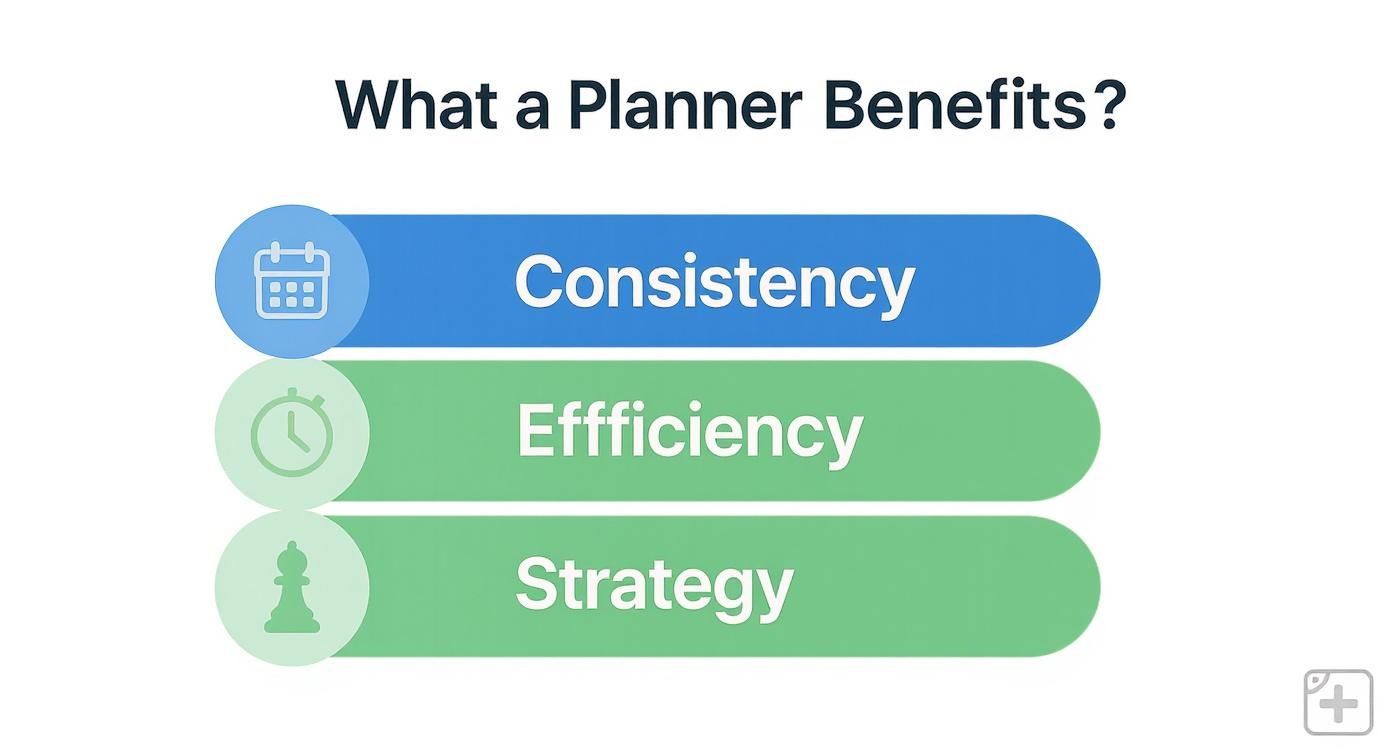
- Content Inconsistency: It puts an end to random, sporadic posting that confuses your audience. A consistent schedule builds trust and keeps your brand fresh in people's minds.
- Wasted Time and Effort: Juggling multiple platforms and posting manually is a massive time sink. A planner automates the busywork, giving you back precious hours to focus on strategy and creating great content.
- Lack of Strategic Direction: It's easy to post content that has no real connection to your business goals. A planner forces you to think ahead, ensuring every post helps with lead generation, brand awareness, or whatever you're trying to achieve.
A well-structured social media plan is the difference between simply being active and being effective. It ensures your efforts are not just visible, but valuable.
Let's break down how these benefits translate into tangible results for your marketing efforts.
Core Benefits of Using a Social Media Planner
This table offers a quick summary of the key advantages your business gains by integrating a social media planner into its workflow.
| Benefit | Impact on Your Marketing |
|---|---|
| Time Savings | Frees up hours each week by automating posting and batching content creation. |
| Improved Consistency | Ensures a steady stream of content, which algorithms favour and audiences appreciate. |
| Strategic Alignment | Every post is tied to a specific campaign or goal, maximising your return on investment. |
| Enhanced Collaboration | Teams can work together seamlessly, with clear visibility on who is doing what and when. |
| Data-Driven Decisions | Centralised analytics help you see what's working and refine your strategy over time. |
By bringing these elements together, a planner doesn't just make your life easier—it makes your marketing smarter.
The Strategic Shift from Doing to Directing
When you start using a social media planner, your role fundamentally changes. You stop being a content creator scrambling for daily ideas and become a strategic director who oversees a complete marketing campaign. You get a bird's-eye view of your entire content calendar, which makes it easy to spot gaps, jump on opportunities, and maintain a healthy mix of promotional, educational, and fun posts.
For instance, imagine you're planning a product launch. You can map out the entire campaign weeks in advance—from the initial teaser posts and behind-the-scenes glimpses to the big announcement, customer reviews, and final call-to-action. Each piece is perfectly timed and coordinated across all your channels, creating a powerful and seamless experience for your followers.
Trying to pull that off with on-the-fly posting is next to impossible. With a clear plan, you're not just posting; you're executing a deliberate vision that builds your brand's authority and keeps your audience hooked.
Aligning Your Plan with German Social Media Habits
A brilliant social media planner is only as good as the content you put into it. And for that content to land, you need to know exactly where your audience is spending their time online. It's about more than just having good ideas; it's about understanding the unique digital hangouts of your potential customers in Germany.
Let's face it, the German social media scene isn't one-size-fits-all. Younger crowds flock to one type of platform, while older generations prefer another. Guesswork just won't cut it. Your strategy needs to be built on a solid foundation of data that shows you where to focus your energy for the biggest impact.
Understanding German Platform Preferences
The first step is to get clear on which platforms matter most to the people you want to reach. A well-structured social media planner lets you stop throwing content at the wall to see what sticks and start tailoring your approach for each channel.
Here’s a rough guide to where different age groups in Germany are most active:
- Ages 16-29: This group lives on fast-paced, visual content. If you want to reach them, Instagram and TikTok are non-negotiable. Think Reels, Stories, and tapping into the power of influencers.
- Ages 30-49: While they're definitely still scrolling Instagram, Facebook is a major player for this demographic. They respond well to a mix of videos, helpful articles, and conversations within community groups.
- Ages 50-64: For this audience, Facebook is king. They use it to keep up with friends and family, follow news, and connect with their hobbies. Deeper, more thoughtful posts in familiar formats tend to perform best here.
This chart really drives home how different platforms dominate the German market.
You can see the massive reach of platforms like YouTube and WhatsApp, but also the continued strength of Facebook, which is a key insight when you're planning a broad strategy.
Turning Data into Actionable Content Pillars
So, you know where your audience is. Now what? The next move is to translate that knowledge into actual content pillars—the core topics you'll talk about consistently. This is where your planner becomes your strategic command centre.
Imagine you're a German fashion brand. Your planner might look something like this:
- TikTok & Instagram Reels: Schedule daily "Outfit of the Day" clips and quick styling tutorials to catch the eye of your 16-29 year old audience.
- Facebook Posts: Plan weekly posts on sustainable fashion or share customer stories to build trust with your 30-49 year old followers.
- Facebook Group Content: Create exclusive Q&A sessions for your most loyal customers, knowing this will likely resonate most with the 50+ age group.
This way, every single piece of content has a clear purpose, platform, and audience. Of course, to know if it's working, you need to watch your metrics. If you want to get better at that, check out our guide on understanding social media analytics.
The goal isn't just to be present on every platform, but to be purposeful. Your social media planner should reflect a deliberate choice to meet each audience segment where they are most engaged.
This isn't just theory; it's essential for efficiency. Back in 2021, data showed that with 45 percent of Germans on social media, the average user was active on almost six different platforms. A planner is the only sane way to manage a multi-channel presence without getting overwhelmed.
Integrating Insights into Your Daily Workflow
Your planner shouldn't be a static calendar you set and forget. It needs to be a living document that evolves with what you learn. Start using features like labels or categories to tag your posts by target audience (e.g., "Gen Z," "Millennial") and by platform (e.g., "Instagram Story," "Facebook Post").
When you do this, your planner transforms from a simple to-do list into a strategic dashboard. You can see at a glance if you're giving enough love to your most important customers or if your content is skewed too heavily towards one platform. It’s this level of organisation that separates a reactive, "post-and-pray" approach from a proactive strategy that actually delivers results.
Essential Features of a Powerful Planner
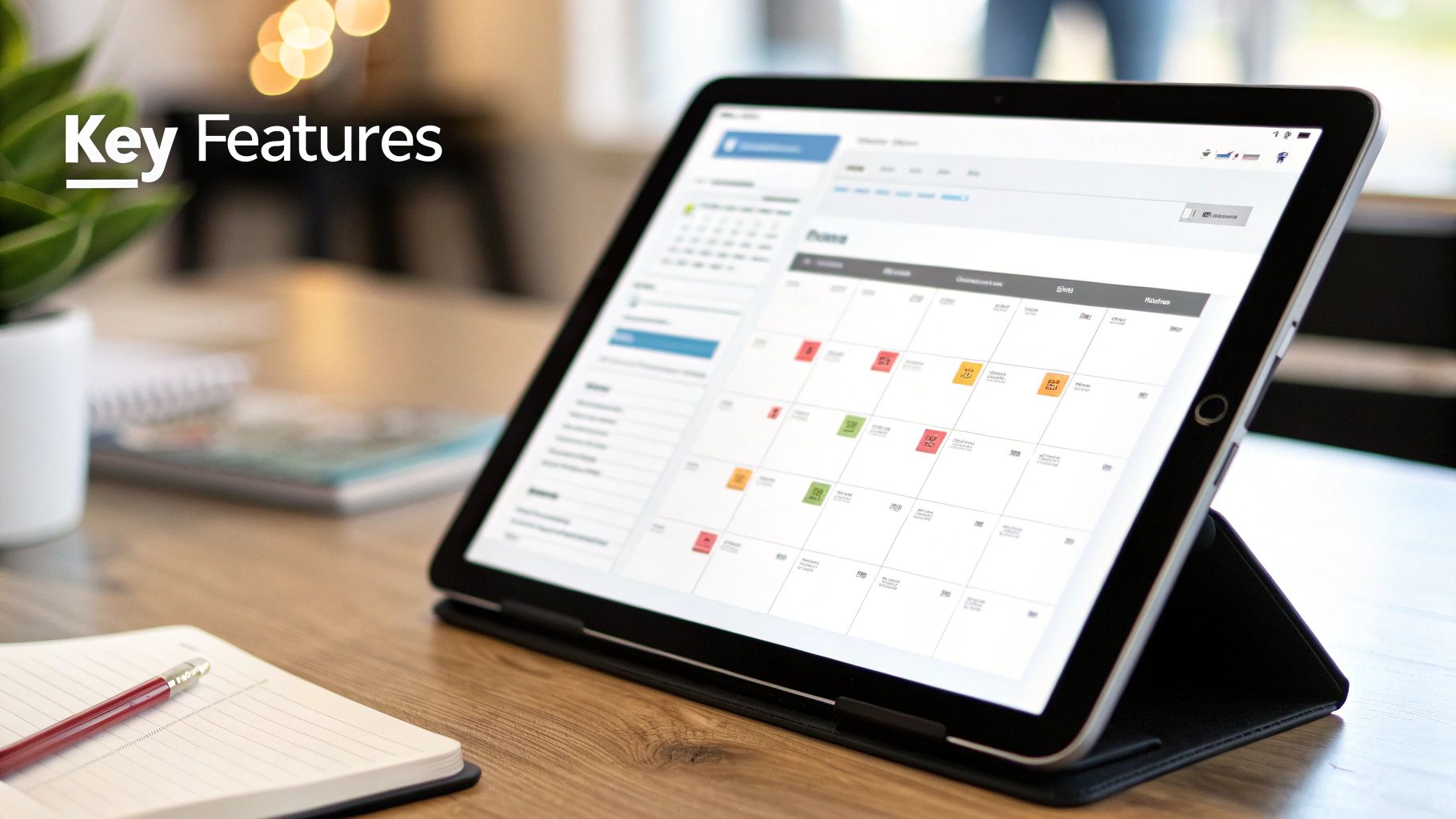
When you start looking for a social media planner, it can feel a bit overwhelming. There are so many options, and they all promise to make your life easier. But while most tools can schedule a post, the ones that really make a difference do so much more. They become the command centre for your entire content strategy.
Think of it this way: a basic calendar is like a simple paper map. It shows you the destination, but that’s about it. A truly powerful planner is more like a complete GPS system. It gives you real-time traffic updates (analytics), suggests better routes (content ideas), and lets you see the whole journey on one screen.
So, let's dive into the features that separate the basic tools from the indispensable ones.
Visual Content Calendar And Scheduling
The heart of any good social media planner is its visual calendar. This is where you get a bird's-eye view of everything you've got lined up. It lets you see what’s going out on each platform, easily spot any gaps in your content, and shuffle things around with a simple drag-and-drop. It’s your mission control.
But it’s more than just a tidy layout. A great calendar helps you see the story your brand is telling over weeks and months. This is vital for planning joined-up campaigns and making sure you have a healthy mix of promotional, educational, and fun content. You don't want to accidentally bore your audience with the same type of post over and over.
At its core, the ability to schedule social media posts in advance is what frees up your time, letting you batch your work and focus on other things.
A visual calendar isn't just for organisation; it's for seeing the bigger picture. It helps you shift from just posting content to actually telling a story.
Collaboration And Approval Workflows
As your brand grows, social media is rarely a one-person show. A top-tier planner has to make teamwork feel effortless. This means letting multiple team members draft, edit, and leave comments on posts right inside the platform, getting rid of those messy email chains and chaotic spreadsheets for good.
Just as important are approval workflows. We’ve all heard horror stories of a junior team member posting something with a typo or an off-brand image by mistake. An approval system acts as a safety net, requiring a manager to sign off on content before it can go live. This simple step is a massive safeguard for your brand’s reputation.
These workflows are critical for a few key reasons:
- Brand Safety: Every post is checked for accuracy, tone, and brand consistency.
- Efficiency: The review process is crystal clear, removing delays and confusion.
- Accountability: You have a clear record of who created, edited, and approved every single post.
Central Asset Library And Analytics
How much time do you waste digging through folders for logos, brand images, or approved video clips? A powerful planner solves this headache with a central asset library. Think of it as a cloud-based digital cupboard where all your creative files live, organised and ready for the whole team to use. It’s a huge time-saver and ensures everyone uses the right assets.
Finally, any planner without built-in analytics is leaving you to guess what’s working. You need data to know what your audience actually cares about. Good planners have integrated analytics that show you key metrics like engagement, reach, and follower growth, all in one place. This feedback loop is essential for tweaking your strategy and proving that your social media efforts are actually paying off.
How to Choose the Right Social Media Planner
Picking the right social media planner can feel a bit overwhelming, but it doesn't have to be. It’s a lot like choosing a vehicle for a road trip. A solo entrepreneur might just need a zippy scooter (a simple spreadsheet) to get around, while a large agency needs a fully-equipped tour bus (a sophisticated software platform) to get the whole crew to the destination.
The secret is to match the tool to your actual needs, not the other way around. If you break down your decision into a few key areas—who's on your team, what's your budget, and which features you can't live without—you'll quickly filter out the noise. The goal is to find a planner that feels like a natural extension of your brand, not just another piece of complicated software to learn.
Assess Your Team and Workflow
First things first: take an honest look at who will be using this tool and how you all work together. A planner that’s a dream for a one-person show will quickly create bottlenecks for a growing team.
-
For Solo Entrepreneurs: Your world revolves around speed and simplicity. You need a tool with a clean interface that lets you schedule posts quickly and maybe even offers up some content ideas. The last thing you need is a system bogged down with complex team features you'll never touch.
-
For Small Teams: It’s all about collaboration. Look for planners that offer shared content calendars, comment threads for giving feedback, and straightforward approval workflows. This keeps everyone on the same page and helps prevent those "oops, did I post that?" moments.
-
For Large Agencies: You need a planner that provides serious scalability and control. Features like multi-level approvals, separate workspaces for each client, and in-depth reporting become non-negotiable when you’re managing multiple brands at once.
Define Your Budget and Key Features
Once you've figured out who the planner is for, you can decide what you're willing to spend and what features are absolute must-haves. A free spreadsheet can be a great starting point, but as your strategy gets more ambitious, you'll probably need something with a bit more horsepower.
Try making a checklist of your non-negotiables. Think of this as your filter for cutting through the marketing hype when you start comparing different platforms.
Your Feature Checklist Should Include:
- Platform Integrations: Does it connect smoothly with all the social networks you’re using now and the ones you plan to use in the future?
- Ease of Use: How intuitive is the interface, really? A powerful tool that nobody wants to use is a wasted investment.
- Analytics and Reporting: Can you easily track what’s working and show the return on your efforts?
- Customer Support: When something inevitably goes wrong, how quickly and effectively can you get help?
As you evaluate potential planners, you might also want to look into innovative solutions like the Auralume AI platform, which uses artificial intelligence for more advanced planning and content features.
Consider Your Target Audience
The planner you choose should also make sense for the audience you're trying to reach. For instance, if you know where your audience hangs out online, you can make sure your tool has the right integrations.
As of early 2025, Germany had around 65.5 million social media users, which is more than 77% of the entire population. With 83.4% of German adults active on these platforms, and Facebook still reaching a huge chunk of internet users, your planner absolutely must be able to manage campaigns on these major networks effectively. You can dig into more German social media trends at DataReportal.
Choosing a social media planner isn't just about scheduling posts; it's about investing in a system that supports your long-term business goals and grows with you.
By following this simple framework—sizing up your team, setting your budget and must-haves, and keeping your audience in mind—you can confidently navigate the sea of options. You'll be ready to ask the right questions and pick a planner that genuinely helps your brand shine online.
Building Your First Social Media Content Plan
Alright, you've picked out your social media planner. Now it's time to roll up your sleeves and put it to work. This is the moment we turn that empty calendar into a living, breathing roadmap for your brand. Think of it like stocking a kitchen—you wouldn't start cooking without a recipe and the right ingredients, right?
Building a content plan from the ground up can feel like a huge task, but it’s really just a series of small, manageable steps. We'll walk through defining your core themes, brainstorming some creative ideas, setting a posting schedule you can actually stick to, and getting your first month of content locked in.
Define Your Core Content Pillars
First things first, let's talk about content pillars. These are the main topics or themes your brand will consistently talk about. They’re the foundation of your whole strategy, making sure every single post feels relevant to your audience and connected to your business goals. For a social media planner to be truly effective, these pillars need to be crystal clear.
Let's imagine you run a local bakery here in Germany. What are the big stories you want to tell? Your pillars could be something like:
- Behind the Scenes: Giving people a peek into the craft of baking, introducing your amazing team, and showing off the high-quality ingredients you use.
- Product Spotlights: Making people’s mouths water with gorgeous photos and videos of your pastries, cakes, and breads.
- Community Engagement: Sharing photos from happy customers, promoting local events, and celebrating stories from the neighbourhood.
- Helpful Tips & Tricks: Offering simple baking advice or coffee pairing ideas that your followers will genuinely find useful.
Having these pillars gives your content a real sense of structure and stops you from ever staring at a blank screen, wondering what to post. When you're ready to get creative, you’ll need to explore various strategies for effective content creation to bring these pillars to life.
Brainstorm and Organise Post Ideas
Now for the fun part: letting the ideas fly. Using your pillars as a guide, just start jotting down every post idea that comes to mind. Don't hold back or second-guess anything at this stage; just get it all out.
Sticking with our bakery example:
- Behind the Scenes: How about a quick video of your baker kneading sourdough? Or a "Meet the Barista" post? Maybe an Instagram Story about where you source your local flour.
- Product Spotlights: A stunning, high-quality photo of your new seasonal tart. A Reel showing how you expertly decorate a birthday cake. You could even run a customer poll asking them to vote for their favourite croissant.
- Community Engagement: A "Customer of the Week" feature would be great. Or a post promoting the local farmer's market. Simply sharing a glowing review can work wonders, too.
- Helpful Tips & Tricks: A short guide on how to keep bread fresh at home. A carousel post on "5 Ways to Enjoy Your Morning Coffee." Or a quick, simple recipe for a weekend bake.
Once you have a good list of ideas, you can start slotting them into your social media planner. This is where a good tool really shines, helping you see your content mix at a glance and making sure you’ve got a healthy balance across all your pillars.
Establish a Consistent Posting Cadence
On social media, consistency is what builds momentum. Your posting cadence—how often you post on each platform—needs to be realistic for you. It’s far better to post three fantastic updates every week without fail than to post twice a day for one week and then go silent for two.
Start with a schedule you know you can manage. For our German bakery, that might look like:
- Instagram: 4-5 times per week (a mix of Reels, feed posts, and plenty of Stories).
- Facebook: 3-4 times per week (with a focus on content that builds community).
Knowing your audience’s habits is a game-changer here. Demographic data shows that in Germany, Facebook had 43.6 million users as of October 2025, with the 25-to-34 age group being the most active. Knowing that the user base is slightly majority female (51.4 percent) can also help you tailor your content for better results.
A successful content plan isn't about posting constantly; it's about posting with purpose and consistency. Use your social media planner to create a rhythm that your audience can rely on.
This organised approach turns social media from a reactive chore into a strategic part of your business. To go even deeper, check out our guide on creating a comprehensive social media content plan. By planning your first month, you give yourself the breathing room to focus on what really matters: engaging with your community and figuring out what resonates, instead of scrambling for what to post next.
Frequently Asked Questions
Even when you've found the perfect social media planner, a few practical questions always pop up. This is where we’ll tackle those nagging little details that can make or break your workflow. Think of it as a quick-reference guide to help you move forward with confidence.
From figuring out how far ahead to plan to deciding when to graduate from a free tool, these answers will help you fine-tune your process and get the most out of your new planner.
How Far in Advance Should I Plan My Content?
This is probably the most common question I get asked, and the honest answer is: it depends. There’s no magic number that works for everyone, but understanding the different planning cadences will help you find the right rhythm for your brand. A good planner will be flexible enough to handle any of them.
-
Weekly Planning: This is perfect if your brand thrives on being reactive and jumping on breaking news or viral trends. It keeps you incredibly nimble. The trade-off? It can feel like you’re constantly stuck on a content hamster wheel, which is a fast track to burnout.
-
Monthly Planning: For most businesses, this is the sweet spot. Planning a month at a time gives you enough space to think strategically and build out small campaigns, but you're still agile enough to react to unexpected opportunities. It’s all about consistency without being completely rigid.
-
Quarterly Planning: Taking a 30,000-foot view like this is brilliant for mapping out your big-ticket items—major campaigns, product launches, and seasonal pushes. It ensures your cornerstone content is locked in. You’ll still need to fill in the gaps on a monthly or weekly basis to keep things fresh, though.
Honestly, the most successful brands I’ve seen use a hybrid approach. They’ll have a quarterly skeleton for their major marketing beats, a more detailed monthly calendar for their core content pillars, and then they leave a few slots open each week for those spontaneous, in-the-moment posts. It’s the best of both worlds: structure and flexibility.
When Is a Free Planner Enough?
Starting with a free social media planner—whether it’s a simple spreadsheet or a basic freemium tool—is a smart move. It gets you into the habit of being organised without costing a penny. For individuals or tiny businesses just starting out, these tools are often all you need.
A free planner is probably the right fit if:
- You’re a solopreneur managing your own social media.
- You’re only active on one or two platforms.
- All you really need is a basic calendar to see what’s posting when.
- You don’t have a team that needs to collaborate or approve posts.
But as your brand grows, you'll eventually start to feel the pinch. The limitations of a free tool will become very apparent, very quickly.
The moment you spend more time fighting with your free planner's limitations than you do creating great content, it’s time to upgrade. Think of a paid tool as an investment in your own time and sanity.
It’s time to consider a paid planner when you need more firepower. This usually happens when you start managing multiple client accounts, need to collaborate with a team, require approval workflows to keep your brand messaging tight, or want detailed analytics to prove your social media ROI.
How Do I Measure the Success of My Plan?
Your social media planner is much more than a glorified calendar; it's a treasure trove of data. Measuring the success of your plan is the only way to know what’s actually connecting with your audience and to prove your efforts are paying off. If you’re not tracking your metrics, you’re flying blind.
The trick is to focus on the key performance indicators (KPIs) that tie directly back to your actual business goals. It's easy to get distracted by vanity metrics, but they won't tell you what's really driving results.
Here are the core metrics you should be tracking:
- Engagement Rate: This is all about how involved your audience is. It’s your likes, comments, shares, and saves. A high engagement rate is a clear sign that your content is resonating.
- Reach and Impressions: Reach tells you how many unique people saw your post, while impressions are the total number of times it was viewed. These are your go-to metrics for tracking brand awareness.
- Click-Through Rate (CTR): This one is simple: of the people who saw your post, how many clicked the link? CTR is crucial for driving traffic from social media to your website.
- Conversion Rate: For many, this is the ultimate measure of success. It tracks how many people took the action you wanted them to—like signing up for a newsletter or buying a product—after clicking your link.
The analytics dashboard inside your planner is the best place to start. Make it a habit to check in regularly to see which posts are your star performers. Use those insights to do more of what works and less of what doesn't. That’s how you turn your social media plan into a powerful engine for growth.
Ready to stop guessing and start planning with a tool that works as hard as you do? Trustypost uses AI to generate on-brand post ideas, organises your content in a visual calendar, and schedules everything in minutes. Reclaim your time and publish content that truly connects. Start your 7-day free trial today at https://trustypost.ai and see the difference for yourself.