

A solid social media content plan is the secret sauce that turns a random collection of posts into a powerful engine for growth. It’s your blueprint, dictating what you post, when you post, and most importantly, why. This strategic approach is what separates the brands that thrive online from those that just make noise.
It's about moving away from guesswork and towards consistent, measurable results.
Build a Foundation for Your Content Plan

Before you even think about writing a single caption, you need to lay some serious groundwork. A powerful social media content plan isn't just a list of fun ideas; it’s a strategic document built on clear goals and a brutally honest understanding of where you currently stand.
Without this foundation, you risk creating content that looks pretty but accomplishes absolutely nothing for your business. This initial phase is all about asking the right questions and finding data-driven answers, not just going with your gut feeling.
Define Your Goals and KPIs
Let’s be honest: "get more followers" isn't a goal. It's a wish. To create a plan that actually works, you have to define what success truly looks like in concrete, measurable terms. The trick is to tie your social media efforts directly to your bigger business objectives.
For instance, if your main business goal is to boost online sales, then your social media goal should be to drive website traffic and conversions. If you're trying to establish yourself as a thought leader, you should be aiming to increase your share of voice and positive sentiment. It's that simple.
Here are a few examples of what real, specific goals look like:
- Increase website click-throughs from Instagram Stories by 15% this quarter.
- Generate 25 qualified leads every month through our LinkedIn content.
- Boost brand mentions on X (formerly Twitter) by 20% over the next six months.
Every goal needs a matching Key Performance Indicator (KPI) so you can track your progress. This clarity ensures every piece of content you create has a clear purpose.
Conduct a Thorough Social Media Audit
Next up, it's time for an honest look in the mirror. A social media audit is where you dive into your existing profiles to figure out what's working, what's a total flop, and where your hidden opportunities are. This isn’t about being self-critical; it’s about gathering cold, hard data.
Start by looking at your best-performing posts from the last six months. What’s the common thread? Are they videos, carousels, or simple text updates? Dig into the topics, tones, and formats that clearly get your audience excited.
Then, do the same for your worst-performing content. Finding these patterns is just as crucial because it tells you exactly what to stop doing. This process gives you a data-backed starting point for your new plan and is a core part of building a stronger social media content strategy that truly resonates.
Analyse Your Competitors
You can't win the game if you don't know who you're playing against. Analysing your competitors is essential for finding your own unique voice in a crowded space. This isn't about copying what they do—it's about spotting their strengths, weaknesses, and the gaps you can strategically fill.
Pick 3-5 of your key competitors, both direct and indirect, and put their profiles under the microscope:
- Platforms: Where are they most active? Where do they get the most traction?
- Content Pillars: What are the recurring themes or topics they always talk about?
- Engagement: Which of their posts are getting all the likes, comments, and shares?
- Audience Response: Read the comments. Is the sentiment positive, negative, or just indifferent?
A great competitor analysis doesn't just show you what works in your industry; it highlights what everyone else is completely ignoring. That’s where you’ll find your golden opportunity to stand out.
You might notice, for example, that all your competitors are posting super-polished, corporate videos. This could be your chance to win over the audience with more authentic, behind-the-scenes content that feels real. To get more ideas on building a winning strategy, digging into a complete social media marketing strategy playbook can provide some brilliant insights. This foundational work is what transforms your social media from a daily chore into a powerful business asset.
Pinpoint and Understand Your Audience
Crafting a social media plan without knowing your audience inside and out is a bit like shouting into the void. You can have the most brilliant message in the world, but if you're not speaking the right language to the right people, it simply won't land. To make a real impact, you have to go beyond surface-level demographics and truly get to know the people on the other side of the screen.
It all starts with building out detailed audience personas. These aren't just dry data points; they're semi-fictional profiles of your ideal customers. Forget "women, aged 25-34." Think more like "Creative Clara, a 28-year-old graphic designer in Hamburg who champions sustainable brands, gets her news from Instagram Stories, and binges DIY home décor tutorials on TikTok."
See the difference? When you have Clara in mind, you stop guessing and start creating content you know she'll love.
Digging Deeper with Psychographics and Behaviour
Demographics tell you who your audience is, but psychographics explain why they tick. This is where the real gold is for your content strategy. It’s time to put on your digital detective hat.
A great place to start is your existing platform analytics. Most social networks provide a surprising amount of detail about your followers' interests, their online habits, and even the other accounts they follow.
Here’s what you should be looking for:
- Interests and Hobbies: What themes pop up again and again? Is it vintage fashion, Formula 1, or urban gardening?
- Values and Beliefs: What matters to them? Do they prioritise eco-conscious products, community initiatives, or tech innovation?
- Online Behaviours: When are they actually online and scrolling? Do they prefer watching long-form videos or tapping through quick image carousels?
And don't overlook your most valuable source of information: your current customers. A quick survey or a simple poll in your stories can give you direct feedback on what they want to see from you. Honestly, that kind of qualitative insight is often more powerful than any spreadsheet.
The infographic below shows how a fictional brand might map out its audience, revealing crucial clues for its content planning.
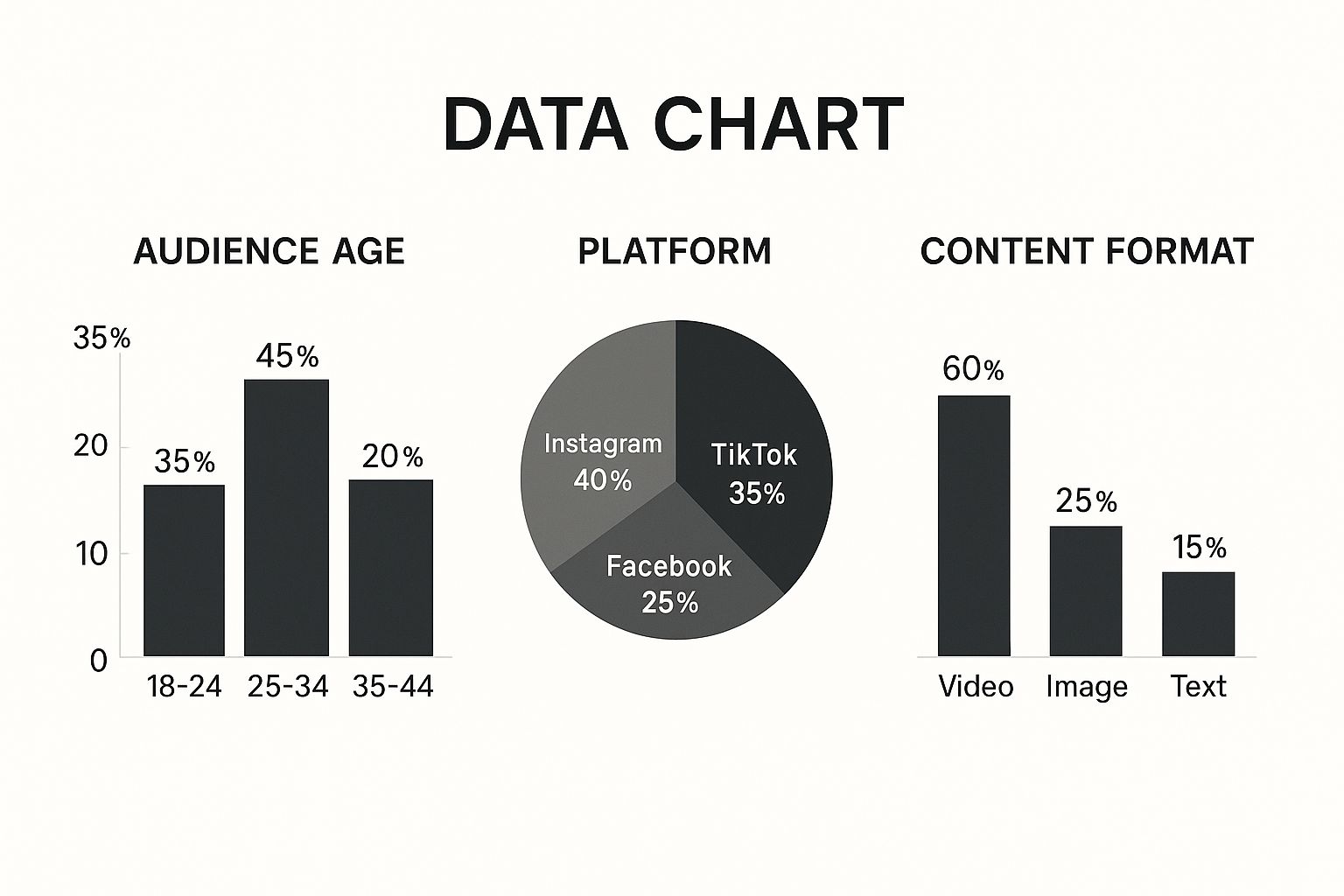
It’s immediately clear that Instagram is the main stage for this brand's audience, and video is the star of the show. That single insight is enough to steer an entire content calendar.
Tailoring Content for Different Generations
The way a teenager uses social media is worlds apart from how their parents do. Acknowledging these generational differences is vital for any content plan, especially in a market like Germany where social media adoption is so widespread.
The 2025 ifo Education Survey, for instance, found that a staggering 90% of adults and 96% of young people in Germany use social platforms daily. Younger users (16-29) are almost guaranteed to be on TikTok and Instagram, consuming short-form videos and jumping on trends. Meanwhile, those aged 30 to 49 tend to be more active on Facebook and Instagram, where they engage with a mix of visuals and more in-depth content like tutorials or industry news. You can get more details by exploring the full results of the ifo Education Survey 2025.
To help you visualise this, here’s a quick breakdown of typical content preferences across different German age groups.
German Social Media User Content Preferences by Age Group
| Age Group | Preferred Platforms | Favoured Content Formats |
|---|---|---|
| 16-29 (Gen Z) | TikTok, Instagram, Snapchat, YouTube | Short-form video (Reels, TikToks), authentic/behind-the-scenes content, memes, influencer collaborations, user-generated content campaigns. |
| 30-49 (Millennials) | Instagram, Facebook, LinkedIn, Pinterest | How-to guides, tutorials, infographics, product reviews, longer-form video, story-based content with polls and Q&As. |
| 50+ (Gen X & Boomers) | Facebook, YouTube, WhatsApp | Informative articles, community group discussions, detailed videos, family-oriented content, news updates. |
This table highlights just how important it is to adapt your approach.
Understanding these distinctions means you can tailor not just the topic but the entire format and tone. A quick, trend-driven video might be perfect for your Gen Z audience, while a detailed carousel post explaining a complex idea could be a huge hit with your Millennial followers on a totally different platform.
By blending demographic data with psychographic insights and a solid awareness of generational habits, you build a rich, multi-dimensional picture of your audience. This clarity ensures every post, video, and story you create is relevant, engaging, and perfectly timed to connect with the people who matter most. It’s the foundation for turning followers into a genuine community.
Choose Your Core Platforms and Content Pillars

Let’s be honest, the pressure to be everywhere on social media is immense. But trying to master every single platform is a fast track to burnout and, frankly, mediocre content. A truly effective social media content plan isn't about casting the widest net possible; it’s about fishing where the fish actually are.
Spreading your efforts too thin just means your message gets lost in the noise and you can't keep up the pace. The smarter approach? Pick a couple of core platforms where you know your audience hangs out and where you can really commit to creating great stuff. That audience research you just did? That's your treasure map. If your people are all over Instagram and LinkedIn, that’s where you need to be, no matter how much buzz TikTok is getting.
Selecting Your Main Platforms
Choosing your platforms shouldn’t be a gut feeling. It needs to be backed by data. Here in Germany, for example, there are over 67.8 million people on social media. The average person juggles around 5.4 accounts, so you’re fighting for their attention.
When you look at the market share, Facebook still leads the pack at 48.15%, with Instagram coming in at 26.65%. YouTube and TikTok are growing, but they're not quite at the same level yet. For many German brands, this data paints a pretty clear picture: starting with a strong focus on Facebook and Instagram is a solid, strategic move. If you're keen to dive deeper into these numbers, it's worth exploring more about Germany's 2025 digital marketing landscape.
To help you decide, here’s a quick rundown of what each platform does best:
- Instagram: A visual playground. Perfect for brands in fashion, food, travel, or anything lifestyle-related where high-quality images, Reels, and engaging Stories can really pop.
- Facebook: The community hub. Its massive, diverse user base makes it fantastic for building local communities, sharing news, and running detailed product showcases through groups and pages.
- TikTok: The home of authentic, short-form video. If your brand has a playful personality and you're up for jumping on trends to connect with a younger crowd, this is your spot.
- LinkedIn: The B2B powerhouse. It's all about professional networking, sharing industry knowledge, and establishing thought leadership. Think company news, deep-dive articles, and career-focused content.
The goal isn’t to pick the most popular platform, but the most profitable one for your brand. A small, highly engaged community on a niche platform is always more valuable than a huge, indifferent following on a mainstream one.
Establishing Your Core Content Pillars
Okay, so you’ve picked your platforms. Now, what are you actually going to talk about? This is where content pillars save the day. Content pillars are the 3-5 central themes that your brand will own, day in and day out. Think of them as the main sections of your brand’s magazine—every single post should tie back to one of them.
This approach gives your content strategy focus and consistency. It’s the difference between staring at a blank calendar in a panic and confidently brainstorming ideas that you know will resonate.
Bringing Pillars to Life with Examples
Let's make this real. Imagine you run a local, sustainable coffee shop. Your content pillars might look something like this:
- Bean-to-Cup Education: This is where you establish your expertise. You’d post about your ethical sourcing practices, introduce the farmers you partner with, or share tutorials on different brewing methods.
- Community Spotlight: Here, you build connections. Feature photos of your regular customers (with their permission, of course!), shout out other local businesses you love, or promote events happening in your café.
- Behind the Scenes: This humanises your brand. Share fun clips of your baristas perfecting their latte art, show the bean roasting process, or post a "day-in-the-life" video that gives people a peek behind the counter.
- Sustainable Living Tips: This pillar reinforces your core values. Share content that goes beyond coffee, like tips for reducing waste at home or cool ways to reuse coffee grounds in the garden.
By defining these pillars, you’re not just posting for the sake of it. You’re building a framework where every piece of content has a clear purpose, strengthens your brand identity, and genuinely serves your audience. That’s how you turn a simple posting schedule into a strategic and successful social media content plan.
Alright, you’ve got your platforms chosen and your content pillars defined. Now comes the fun part: actually deciding what you're going to post day in and day out. This is where we move from big-picture strategy to the nitty-gritty of creating a social media feed that people genuinely want to follow.
The goal here is to create a blend of content that not only showcases your brand but also gives your audience a real reason to stick around. It's the difference between a brand that builds a loyal community and one that just shouts into the void.
Getting the 80/20 Content Mix Right
One of the biggest blunders I see brands make is turning their social media into a constant sales pitch. It’s a huge turn-off. The best way to avoid this is by sticking to the classic 80/20 rule.
The idea is simple: 80% of what you post should be genuinely useful, interesting, or entertaining for your audience. The other 20% can be your promotional stuff—the direct "buy now" or "sign up" content.
Think about it like any good relationship. You have to give more than you take. By consistently providing value, you earn the trust and attention needed for that 20% to actually work. When you do ask for the sale, your audience is far more likely to listen because you've already proven you're not just there to sell to them.
Let's imagine you run a local bookshop. Here’s how that 80/20 mix could play out:
-
80% (The Value-Packed Stuff)
- Sharing a mini-review of a new fantasy novel (Educate).
- Posting a beautiful photo of a cosy reading nook in the shop (Inspire).
- Running a poll asking followers what book they'd take to a desert island (Engage).
-
20% (The Promotional Bit)
- Announcing a "buy one, get one half price" weekend offer.
- Sharing a customer's Instagram post about their latest purchase, with a clear link to your online store.
This approach keeps your feed feeling like a valuable community hub, not just a digital flyer.
The Smart Way to Use Other People's Content
Let's be real: creating amazing, original content all the time is exhausting. That's where content curation comes in, and it's a game-changer. Curation simply means finding and sharing brilliant, relevant content from other people or brands.
Done right, it positions you as a tastemaker in your niche. You become the go-to source for the best information, which builds incredible trust.
But don't just hit the retweet button and call it a day. The key is to add your own spin. Tell your audience why you think a particular article is a must-read or pull out a key quote and ask for their opinion. This adds a layer of value and keeps your brand's voice front and centre. If you're looking to get more efficient, there are some essential social media content creation tools that can help you find and schedule curated content without the headache.
Curation isn't just a shortcut for filling an empty calendar. It's a strategic move to become an indispensable resource for your community. When people know you share the best stuff—yours or not—they'll make a habit of checking in with you.
Don't Post a Tweet on Instagram: Match Your Format to the Platform
Every social media platform has its own unique language. A text-heavy post that gets tons of engagement on LinkedIn will die a silent death on TikTok. A huge part of your content plan is deciding not just what to say, but how to say it on each channel.
You need to be aware of the nuances. Take Facebook in Germany, for instance. It's still a powerhouse, with 54.1% of the population on there. The largest group is 25-34 year-olds, but look closer and you'll see women between 45 and 54 outnumber men by 3 million. That's a massive insight! It tells you that visual, community-driven content like photo albums or heartfelt video stories might perform exceptionally well for that audience. You can dig into more data like this from the latest research on German social media users.
Here’s a quick cheat sheet for pairing formats and platforms:
| Platform | What Works Best |
|---|---|
| Stunning Reels, well-designed Carousels, and interactive Stories (polls, quizzes, Q&As). | |
| TikTok | Short, snappy vertical videos that jump on trending sounds; raw, behind-the-scenes footage. |
| Thoughtful articles, expert insights in text posts, data-rich infographics, professional video. | |
| Live video streams, event promotion, posts that spark conversation, photo galleries. |
And never, ever forget the magic of user-generated content (UGC). Actively encouraging your customers to share photos or videos featuring your product is one of the most powerful marketing tools you have. Featuring their content on your feed is the ultimate social proof and makes your community feel seen and valued.
Organise Your Workflow with a Content Calendar

If you've ever found yourself scrambling for a last-minute post idea, you already know why a content calendar is non-negotiable. Consistency is the engine of social media growth, and your calendar is the key that starts it. It’s what turns your brilliant content pillars from abstract ideas into a tangible, day-by-day action plan.
A proper calendar is so much more than a list of post ideas. Think of it as the strategic command centre for your entire social media operation. It allows you to plan weeks or even months ahead, guaranteeing a steady flow of high-quality content that’s always aligned with your goals.
Building Your Master Calendar
Your social media calendar can be as simple as a Google Sheet or as powerful as a dedicated platform like Sprout Social or Asana. Honestly, the tool you choose matters less than how you use it. What's crucial is that your social media content plan gives you a clear, at-a-glance overview of everything that's coming up.
Start by creating a template that works for you. No matter the tool, every entry in your calendar needs to have a few core pieces of information to eliminate guesswork and make team collaboration a breeze.
Here’s a quick look at the essential details that every effective social media calendar needs to track for each post.
Essential Content Calendar Components
| Component | Purpose | Example |
|---|---|---|
| Date & Time | Pinpoints the exact moment the post will go live. | 18 October, 10:30 AM |
| Platform | Specifies which social network the post is for. | |
| Content Format | Clarifies the type of media (e.g., Reel, Carousel, Story). | Carousel (5 slides) |
| Copy/Caption | Contains the final, approved text for the post. | "Behind the scenes of our latest product shoot! ✨ Which of these colours is your favourite? Let us know below! 👇" |
| Visuals/Assets | A direct link to the final image, video, or graphic. | [Link to Dropbox folder with images] |
| Call-to-Action (CTA) | States the specific action you want the audience to take. | "Comment below" or "Tap the link in bio" |
| Status | Tracks the post's progress (e.g., Idea, In Progress, Approved). | Approved |
This level of detail means anyone on your team can step in and immediately understand the plan. It also builds a valuable archive of your past content, making it easy to look back and see what worked.
Finding the Best Times to Post
Posting incredible content when your audience is offline is like performing to an empty theatre. A huge part of organising your calendar is figuring out the peak times your followers are most active and likely to engage. This isn't a one-size-fits-all answer; it varies wildly by platform, industry, and your audience’s unique habits.
The best place to start is right inside your platform analytics. Most social networks, like Instagram and Facebook, offer detailed insights showing when your followers are online, broken down by both the day and the hour. This data is your most reliable guide.
Don’t just look at when they are online; analyse when your best-performing posts were published. You might discover that your audience is online at 8 PM but is most likely to comment and share content posted around lunchtime.
Once you have this data, you can start scheduling your content to go live during these optimal windows. It's a simple tweak that can dramatically boost a post's initial reach and engagement, giving it a much better chance of being picked up by the algorithm. For a deeper dive, our guide on how to schedule social media posts offers more pro tips on mastering your timing.
Using Scheduling Tools to Automate Your Workflow
Let's be realistic: manually publishing every single post at the perfect time just isn't practical, especially as your presence grows. This is where scheduling tools become your best friend. Platforms like Buffer, Hootsuite, or the native schedulers in tools like Meta Business Suite let you set your content to publish automatically.
Scheduling your posts in batches—a practice known as content batching—is a game-changer for productivity. You can sit down for one afternoon and schedule out an entire week or even a month of content. This simple habit frees you from the daily pressure of posting and lets you focus on more strategic work, like engaging with your community and analysing performance.
Better yet, this approach ensures you never miss a posting time, helping you maintain the consistent presence that both algorithms and audiences reward. By pairing a detailed calendar with smart scheduling, you create a reliable, efficient system that keeps your social media content plan running like a well-oiled machine.
Measure Performance to Refine Your Strategy
Getting your social media content plan down on paper is a massive step forward, but the real magic happens next. Think of your plan not as a finished document, but as a living strategy—one that needs to adapt based on what the data tells you. This is where measurement comes in. It’s how you turn good instincts into a powerful, results-driven growth engine.
If you’re not tracking performance, you’re basically flying blind. You could be pouring hours into beautiful content that no one sees, or worse, creating posts that just don’t land with your audience. Regularly checking in on your analytics is what transforms a simple schedule into a smart, responsive tool that gets better over time.
Identify the Metrics That Truly Matter
First things first, let's cut through the noise. Vanity metrics like a million impressions might feel good, but if they don't lead to any real business results, what’s the point? The goal is to focus on data that directly ties back to the business objectives you set at the very beginning of this process.
You don’t need to be a data scientist to get started. Your native platform analytics, like Meta Business Suite or TikTok Analytics, are packed with useful information. The trick is to avoid getting overwhelmed by all the charts and graphs. Instead, zero in on a handful of key performance indicators (KPIs) that tell a clear story.
Here are a few essentials I always recommend starting with:
- Engagement Rate: This is the big one. It shows the percentage of people who saw your content and actually interacted with it—think likes, comments, shares, and saves. A healthy engagement rate is a strong signal that your content is genuinely hitting the mark.
- Reach and Impressions: It’s important to know the difference here. Reach is the number of unique people who see your post, while impressions are the total number of times it was seen. These help you gauge brand awareness and how far your content is travelling.
- Click-Through Rate (CTR): If your post includes a link, the CTR tells you what percentage of viewers actually clicked on it. This is a direct measure of how well your content inspires action and drives traffic.
- Conversions: This is often the ultimate goal. Conversions track how many people took a specific action after clicking your link, whether that’s signing up for a newsletter, downloading a guide, or making a purchase.
Getting a handle on these different metrics is a game-changer. For a deeper dive, our guide breaks down the various social media KPIs you should be tracking to make sure you’re measuring what really counts.
Establish a Simple Review Cadence
Having all this data is great, but it’s useless if you don't do anything with it. The best way to make analysis a regular habit is to build a simple, repeatable review process right into your workflow.
For most businesses, a monthly check-in is the perfect rhythm. It’s frequent enough to spot trends before they go stale but not so often that it feels like a chore.
Just set aside a couple of hours at the end of each month to pull your reports and ask some simple, honest questions:
- What Worked? Pinpoint your top 3-5 posts for the month based on your main goal (e.g., highest engagement or most clicks). Look for a pattern. Was it the format (Reel vs. carousel)? The topic? The tone of the caption?
- What Didn’t Work? Now, do the same for your worst-performing posts. Be objective. Was the visual a bit flat? Was the topic too self-promotional or simply uninteresting?
- What Did We Learn? Boil down your findings into a few key takeaways. For example: "It looks like our audience really responds to behind-the-scenes video content but tunes out when we post text-only graphics."
- What Will We Adjust? This is the most important part. Turn those lessons into concrete actions for next month's plan. That takeaway might become: "Next month, let’s create two more behind-the-scenes Reels and phase out the text graphics."
This cycle of analysing, learning, and adjusting is the secret to long-term social media success. It’s an ongoing conversation with your audience where you listen to their actions and refine your message accordingly.
This disciplined approach ensures your social media content plan is constantly evolving and becoming more effective. You stop guessing and start giving your audience more of what they’ve already shown you they love.