Think of a social media analyser as your brand's digital ears. It's a sophisticated listening tool that tunes into the millions of conversations happening online every second, figuring out what people are really saying about you, your products, and even your competition. It's about moving past vanity metrics like 'likes' and digging into the meaning—the sentiment and context—behind the chatter.
Getting to Know Your Digital Audience
Manually keeping track of every online mention of your brand is simply impossible. A social media analyser does the heavy lifting for you, sifting through the noise to find the signals that matter. This isn't just about counting how many times you're mentioned; it's about grasping the subtleties of public perception.
In today's fast-paced online world, where a single comment can go viral and change a brand's reputation in an instant, these tools are indispensable. They provide clear answers to the big questions that should be driving your strategy:
- What’s the genuine feeling about our latest product launch?
- Are customers raving about a particular feature, or is there a common complaint we need to address?
- How much of the conversation in our industry do we own compared to our key competitors?
By pulling all this data together and making sense of it, an analyser gives you a bird's-eye view of your brand’s health and where you stand in the market.
Understanding Unique Market Behaviours
This kind of deep analysis is even more crucial when you're dealing with markets that have their own distinct digital habits. Germany, for example, is a fascinating case. While internet access is nearly universal, social media use isn't as widespread as in other Western European countries.
Recent figures show that while 93% of German adults are online, only around 51% are active on social platforms. That's a massive 42-point gap between general internet use and social media engagement.
This is precisely where a powerful social media analyser proves its worth. It helps you find out exactly where your target audience hangs out online and what topics get them talking, making sure your marketing budget is spent wisely. Managing this feedback is a skill in itself, and looking into user-generated content moderation strategies can offer some really practical guidance. At the end of the day, it’s this nuanced understanding that transforms raw data into a genuine competitive edge.
How Social Media Analysers Actually Work
To really get what a social media analyser does, you have to look under the bonnet. These aren't just simple counters for likes and shares. They're sophisticated engines that hoover up enormous amounts of messy, unstructured text and somehow turn it all into genuine strategic intelligence.
At its core, the whole process starts with mention tracking. Picture a digital radar that never sleeps, constantly scanning platforms like X (formerly Twitter), Facebook, blogs, and forums for keywords you care about. We're not just talking about your brand name, either. A good analyser keeps an ear out for competitor names, specific products, and important industry hashtags, making sure you never miss a vital conversation.
This first step gathers millions of individual data points. But honestly, raw data is just noise. The real magic begins when the analyser starts making sense of it all.
Deciphering Emotion with Sentiment Analysis
This is where the tool goes from a data collector to an interpreter. Sentiment analysis is all about figuring out the emotional tone behind a piece of text. Using smart artificial intelligence and Natural Language Processing (NLP), the platform reads a post and decides if it’s positive, negative, or neutral.
The best systems are getting frighteningly good at this, even picking up on sarcasm or specific emotions like frustration or delight.
Think about it this way: a sudden wave of negative sentiment could be the first smoke signal of a looming PR fire. If you catch it early, you can step in before it turns into an inferno. In fact, a 2024 Gartner report found that companies using real-time customer feedback are 30% more likely to improve their customer satisfaction scores. It’s a game-changer.
Identifying Patterns and Emerging Trends
Beyond just looking at single mentions, a social media analyser is brilliant at connecting the dots to reveal bigger patterns. It pulls together thousands of conversations to show you what themes keep popping up and which new trends are starting to gain momentum.
Are people constantly raving about that new feature you just launched? Or is there a quiet but growing grumble about a recent update?
By capturing a whole range of reactions and discourse on social media, sentiment analysis supports teams to better understand how their work is being received and engaged with online across different audiences.
This is where you get insights that are pure gold for your content strategy. You can create posts that tap directly into what people are already talking about, making your brand part of the conversation. It's also invaluable feedback that can, and should, find its way back to your product development team.
This table breaks down the essential capabilities that transform raw social data into strategic business assets.
Core Functions of a Social Media Analyser
| Function | What It Does | Strategic Advantage |
|---|---|---|
| Mention Tracking | Continuously scans social media, blogs, and forums for specific keywords like brand names, products, or competitors. | Ensures you capture every relevant conversation, providing a complete view of your brand's online presence. |
| Sentiment Analysis | Uses AI and NLP to classify the emotional tone of each mention as positive, negative, or neutral. | Helps you gauge public perception, identify potential PR issues early, and understand customer satisfaction levels. |
| Trend Identification | Aggregates data to spot recurring themes, popular topics, and emerging conversations within your industry or audience. | Informs your content strategy, uncovers product improvement opportunities, and keeps you ahead of market shifts. |
| Data Visualisation | Translates complex data sets into easy-to-understand charts, graphs, and dashboards. | Makes insights accessible to everyone in your organisation, enabling faster, data-driven decision-making. |
Ultimately, all these functions work together to give you a clear, comprehensive picture of where your brand stands. The key is knowing which numbers matter most. For a deeper dive, check out our guide on choosing the right social media KPIs to measure what counts. A great analyser doesn’t just show you data; it delivers the insights you need to make smarter business moves.
Turning Social Data Into Business Growth
It’s one thing to understand the features of a social media analyser, but it's another thing entirely to turn those functions into real, tangible business growth. This is where the magic happens and where you start to see a genuine return on your investment. When you move beyond simple vanity metrics, you can start using social data to drive meaningful results across your entire organisation.
Think of it this way: every insight you gather is an opportunity. It’s a chance to strengthen your brand, fine-tune your products, and build a much deeper connection with your customers. You're essentially turning raw materials—mentions, comments, shares—into valuable strategic assets.
Enhance Brand Reputation
A solid brand reputation is built on trust, and a social media analyser is your first line of defence in protecting it. By keeping a finger on the pulse of sentiment in real-time, you can catch negative feedback or complaints before they snowball into a full-blown crisis. This proactive stance lets you jump in, solve problems fast, and show your audience that you’re actually listening.
Let's say a clothing retailer spots a recurring complaint about wonky sizing in a new product line. By using their analyser to catch this theme early, they can publicly acknowledge the feedback and offer a solution. In doing so, they not only fix the problem but also prove their commitment to customer satisfaction. That’s how you build loyalty.
By turning unstructured social data into timely, actionable insight, organisations can safeguard their reputation and detect shifts in public opinion before they gain widespread attention.
This ability to manage conversations on your own terms transforms customer service from a reactive, firefighting department into a powerful engine for building a positive brand image.
Inform Product Development
Your customers are constantly telling you what they want. A social media analyser simply helps you listen better. By spotting recurring themes, feature requests, and pain points in their conversations, you get a direct pipeline into your market's brain. This kind of unfiltered feedback is gold for shaping your product roadmap and sparking innovation.
Imagine a software company notices a surge in positive mentions whenever users talk about a specific workflow integration. That data isn't just a nice-to-have; it's hard evidence that investing more in that feature will pay off. It allows you to base your development priorities on real-world demand, not just guesswork. Over time, this customer-first approach leads to better products and users who stick around.
Launch More Effective Marketing Campaigns
Great marketing is all about resonance—making people feel like you get them. A social media analyser provides the audience intelligence you need to create campaigns that truly connect. You can figure out which content formats your audience loves, what topics they're passionate about, and even the slang they use.
This deep understanding helps you shift from generic, one-size-fits-all messaging to highly targeted campaigns that feel authentic. Of course, social media is just one piece of the puzzle. A wider array of AI tools can give your campaigns a serious boost; you can explore some of the best in this guide to top AI marketing software. Adopting this strategic approach ensures your marketing efforts aren't just seen, but felt, leading to much higher engagement and, ultimately, better results.
Analysing Unique Markets Like Germany
Throwing a generic social media strategy at the wall and hoping it sticks just doesn't work in a global marketplace. What lights up audiences in North America can easily fall flat in Europe or Asia. This is precisely why a sharp social media analyser is no longer a nice-to-have for international brands; it’s an essential part of the toolkit.
Germany is a fantastic example of why this matters. It's an economic giant with a deeply connected population, but German social media habits are very much their own. A surface-level glance could lead you to make some expensive mistakes. A proper analysis tool, on the other hand, helps you see past the obvious and understand what really makes German users tick.
This is how you move beyond vague assumptions and build a strategy that feels local and relevant. For a closer look at the mechanics, our complete guide to analytics for social media breaks it all down. It's about making sure your campaigns are built on a bedrock of real data, not just a hunch.
Uncovering Demographic Nuances
One of the most powerful things a social media analyser does is slice and dice audience data with incredible precision. It can tell you which age groups dominate certain platforms or pinpoint where engagement skews heavily towards one gender. This is gold dust when you're trying to craft a message that connects.
Take Germany, for instance. Facebook is still a major player. As of September 2025, it has a staggering 44.2 million users—that's 54.1% of the entire population. While women make up a slight majority at 50.9%, the real story is in the age brackets. The 25-34 group is the largest, but there's a huge gender gap between ages 45-54, where women outnumber men by three million. You can dig into more of these German social media statistics to see how they shape the market.
Understanding these demographic layers is the difference between a campaign that feels authentic and one that completely misses the mark. Nuanced data empowers brands to speak directly to specific audience segments with messages that matter to them.
As you can see, getting these insights right has a direct impact on business growth, from reputation and customer service to the bottom-line results of your campaigns.
Ultimately, effective analysis turns raw audience data into a real strategic advantage. Without this deep, market-specific understanding, global brands are just guessing, wasting time and money on strategies that are a poor fit for the local digital culture. That’s why a powerful social media analyser is an indispensable part of any modern international marketing plan.
How To Choose the Right Social Media Analyser
Picking the right social media analyser feels a lot like choosing a car. You wouldn't buy a massive off-roader just for city driving, and a tiny hatchback won't get you very far on a rugged mountain trail. The best tool is the one that fits your specific journey, your goals, and the terrain you're navigating.
It’s easy to get distracted by flashy features, but the real test is finding a tool with core capabilities that actually solve your problems. A platform that looks incredible but doesn't fit into your daily workflow will just end up gathering dust. What you're really looking for is a tool that feels like a natural extension of your team—one that delivers clear insights without making more work for everyone.
To make sure you're making a smart investment, you need a solid framework for figuring out what you need and comparing it to what's out there.
Define Your Core Requirements
Before you even book your first demo, you need to be crystal clear on what you want the tool to do. Start with some basic questions. Is your main focus managing brand reputation? Are you more interested in competitive intelligence, or is it all about tracking content performance? Each of these goals requires a very different set of features.
As you start your search, keep these criteria in mind:
- Data Accuracy and Depth: How good is the sentiment analysis, really? Can it pick up on sarcasm and context, or does it just give you a generic positive/negative score?
- Platform Coverage: Does the tool cover the social media platforms where your audience actually spends their time? Think beyond the usual suspects like Facebook and Instagram to include places like TikTok or niche industry forums.
- Ease of Use: A powerful tool is worthless if your team can't figure it out. Look for a clean interface and straightforward data visualisations that make the insights obvious.
- Integration Capabilities: Does the analyser play nicely with the other tools you already use, like your CRM or reporting dashboards? Seamless integrations are a huge time-saver and help create a single, reliable source of data.
Evaluate Functionality Against Your Goals
Once you have a clear picture of what you need, you can start sizing up potential tools. Think about your day-to-day work. If your top priority is to level up your customer service, you'll want an analyser with powerful, real-time alerts that can flag urgent customer issues the moment they appear.
On the other hand, if you're laser-focused on content strategy, your must-haves will be strong trend analysis and performance metrics. This is what helps you figure out which topics are hitting home with your audience and measure the true impact of your campaigns.
One of the biggest mistakes people make is choosing a tool simply because it has the longest feature list. It's far better to pick a tool that is exceptional at the few things that are absolutely critical to your success.
At the end of the day, the best social media analyser delivers intelligence you can act on, not just a mountain of data. By carefully matching your business needs to what each platform offers, you can confidently choose a solution that will fuel your growth and deliver a real return on your investment. It’s this thoughtful approach that ensures you end up with the right vehicle for your journey.
All the theory in the world is great, but seeing a social media analyser in action is what really drives the point home. Trustypost isn’t about drowning you in abstract data; it's about turning complex social insights into a practical command centre for your brand strategy. It’s built to connect the dots between what people are saying online and what you should do about it.
This is so much more than just collecting mentions. It’s about visualising trends that genuinely inform your content. Imagine the Trustypost dashboard flagging a sudden spike in positive sentiment around a niche topic. That's your green light—a clear signal to create more content on that very theme. It also keeps you one step ahead of trouble with proactive alerts for any brewing issues.
From Data to Decisions
Trustypost's competitive analysis tools give you a bird's-eye view of the market, showing you exactly where you stand against your rivals. This is crucial for navigating the different ways people behave online, especially in markets with their own unique engagement patterns.
Take a look at this screenshot. It shows how Trustypost organises content ideas based on what's trending right now and what your audience is genuinely interested in.
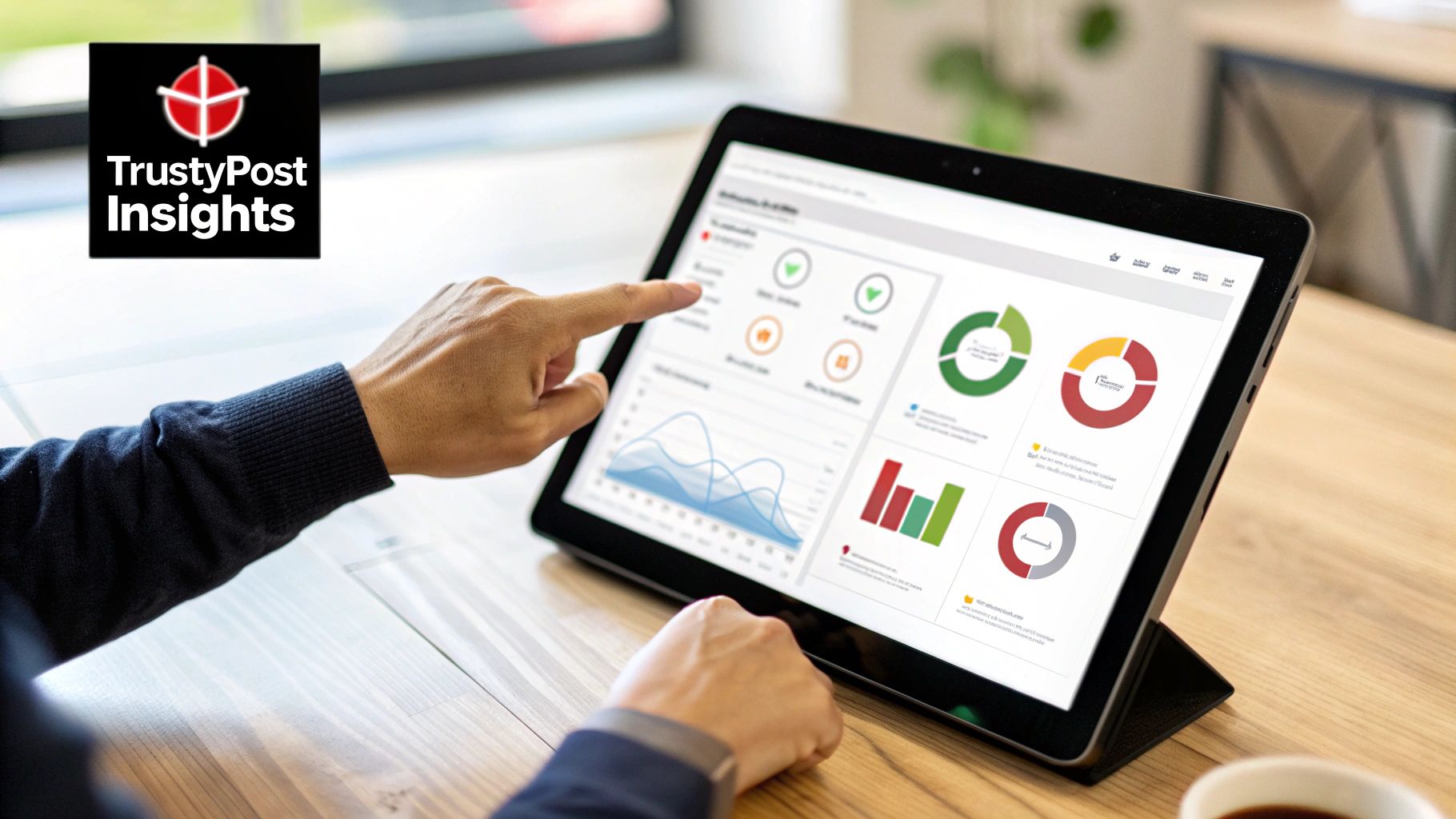
The interface lays out relevant topics so you can quickly pick one and generate posts you know will resonate. That direct line from insight to creation is what makes an analyser a true powerhouse.
Understanding local nuances is everything. In Germany, for instance, a surprising 25% of social media interaction still happens on desktops, which is higher than average and definitely influences the kind of content that performs best. A recent survey from Statista.com shows the huge range of activities Germans get up to on social platforms, from consuming content to engaging with communities.
Trustypost bridges the gap between raw data and impactful action. It gives you the intelligence to not only join conversations but to lead them with content that is timely, relevant, and perfectly aligned with what your audience actually cares about.
By turning analysis directly into content, Trustypost simplifies your entire workflow. Our guide on how to schedule social media posts walks you through taking these insights and building a consistent, high-performing content calendar. It’s the final piece of the puzzle, turning social listening into real, strategic growth.
Common Questions About Social Media Analysers
As you start digging into the world of social data, you’ll naturally have a few questions. It’s completely normal. Getting a handle on these common queries is the best way to feel confident and ensure you're squeezing every bit of value out of your chosen tool.
Let's walk through some of the things people often ask when they first dip their toes into using a social media analyser.
How Accurate Is Sentiment Analysis?
This is the big one, isn't it? The short answer is that modern, AI-powered sentiment analysis is remarkably accurate. For straightforward positive or negative comments, the top tools can hit the mark over 90% of the time.
Where it gets a bit more nuanced is with the tricky stuff—sarcasm, irony, or highly specific industry slang. The best platforms tackle this head-on. They use machine learning models that are always getting smarter, and some even let you tweak the system to better recognise the unique language your audience uses.
A good social media analyser isn’t just about spitting out a score. Its real job is to give you a dependable pulse on public opinion so you can make smarter decisions, faster.
What's the Difference Between Social Listening and Analysis?
This is a fantastic question because these two terms get mixed up all the time. The easiest way to think about it is like this:
- Social Listening is the what. It’s the act of tuning into online conversations to hear what’s being said about your brand, your competition, and your industry as a whole.
- Social Analysis is the so what. This is where you take all that raw data and figure out why these conversations are happening and, most importantly, what you should do about it.
Listening is like gathering all the ingredients for a recipe. Analysis is the chef who actually cooks the meal, turning those raw parts into something meaningful and actionable. A truly powerful social media analyser does both jobs for you—it collects the chatter and then gives you the tools to understand it all.
Ready to turn social insights into effortless growth? Trustypost learns your brand's voice and generates on-brand post ideas daily, helping you stay top of mind. Start your free 7-day trial and see how easy social media can be at https://trustypost.ai.